
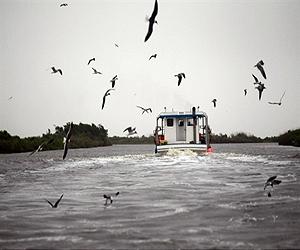
As a sea of crude oil threatens to wash away her livelihood, Margaret Legnon stares at the boats sitting idle in the docks and wonders how long her coastal Louisiana fishing town can get by.
Not to mention what all those shrimp and crab lovers in New York and Detroit and Los Angeles will do if one of the nation's largest sources of wild seafood is poisoned.
"It's going to be ugly," Legnon says of the looming environmental and economic disaster.
Louisiana's fragile wetlands are prime breeding grounds for the fish, crab and shrimp which support a 2.4 billion dollar a year commercial and recreational fishing industry.
Already badly damaged by decades of coastal erosion and the ravages of Hurricane Katrina in 2005, many here worry the marshes which have supported their way of life for generations will be destroyed by the epic oil spill.
Nobody knows when crude will stop gushing from a deep-water well cracked open after an offshore oil platform run by British energy giant BP sank on April 22, two days after a massive explosion that killed 11 workers.
The massive slick has spread to 3,500 square miles (9,000 square kilometers) – about the size of Puerto Rico – and an estimated 200,000 gallons are leaking into the Gulf of Mexico every day.
"We can bounce back from a hurricane – it just tore up stuff," said Legnon, whose husband runs the Off the Hook charter fishing boat company.
"But this kills. The oil kills everything."
Legnon thinks her family will be okay. They have friends who can help them shift their business out to an area which ought to be safe from the spill.
But it will mean leaving Venice, the last town south of New Orleans before the land breaks up into bayous and the gulf.
Venice, and the narrow peninsula leading down to it, seems to be a practical kind of place. Homes and buildings are raised high to avoid the frequent floods.
People here pretty much work in either the fishing or the oil and gas industry and the road to the marina – a major tourist destination – is lined with scrapyards, refineries and rotten ships.
But beneath the laid-back southern hospitality lies an intense pride in place.
"This oil spill threatens not only our wetlands and our fisheries, but also our way of life," Governor Bobby Jindal said at a press conference Saturday.
The mood is tense at Venice Anglers, where the only customers for charter boats these days are journalists trying to capture the first waves of oil as they wash ashore.
There's no music coming from the speakers on the patio. No tourists taking pictures with their catch on the dock.
Captain Chris Calloway, who runs charter fishing trips, jokes with the few people sipping beers on the patio in an attempt to lighten the mood.
But his frustration seeps through when he sits down to talk about the spill, and the fact that BP's engineers still have not managed to stem the flow of oil bubbling to the surface of the Gulf.
"It's Katrina all over again because they got caught with their pants down," Calloway said.
"The world we live in can't live without oil, but by God if you're making multi-billion dollars a day there had better be a backup plan."
The natural beauty and rich waters that draw sport fishermen to Venice from around the world are apparent even on the drive to the marina.
A stiff wind blows tall grass in the marsh as birds swoop in the air and perch in the branches of cypress trees which rise like sentinels from the muddy waters.
Louis Colon walks along the road dipping his small net in and out of a channel. His wife follows behind with a bucket, her pace quickening when he pulls out a foot-long fish, his third of the day.
"Here, it's good fish," said Colon, an immigrant from the Dominican Republic who drives the two hours from New Orleans every weekend to catch their supper.
Colon figures his job at a local hospital will be safe regardless of the economic damage wrought by the spill. But he shakes his head at the thought of losing these waters to the oil.
"It's a big problem that will affect the community," he says before tossing his net back in, perhaps for the last time.
Share This Article With Planet Earth
