
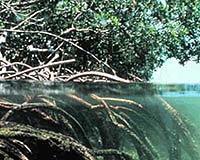
The belief that coastal mangroves and other "green belts" offer protection against tsunamis is wrong and could lull endangered communitees into a false sense of security, researchers said Monday.
The researchers, including experts from Australia's James Cook University, disputed claims that in the 2004 Boxing Day tsunami, some affected villages suffered lower death tolls because they were surrounded by coastal mangroves.
Around 220,000 people were killed or went missing in a dozen countries around the Indian Ocean when a massive earthquake off Indonesia created the tsunami which engulfed entire coastal communities.
After the disaster, the United Nations Environment Programme, non-governmental organisations and some scientists recommended green belts and buffer zones to protect villages from future tsunamis.
But the new research by James Cook University's ARC Centre of Excellence for Coral Reef Studies, the University of Guam and the Wildlife Conservation Society-Indonesia Programme challenged this view.
The scientists reanalysed data from a recent Indian study and found that it was a village's height above sea level and distance from the shore that protected its residents, rather than the surrounding vegetation.
"Our re-analysis revealed that the distance of a village from the coast and the height of the village above sea level explained 87 percent of the variation in mortality among villages," the University of Guam's Andrew Kerr said in a statement released here.
James Baird, from the James Cook center, said there was a danger in overstating the protection given by mangroves and other coastal vegetation.
"It's a false sense of security that they're instilling," Baird said.
"If this belief that mangroves add a protection screen becomes too entrenched, there's a chance people will become complacent and that could have drastic consequences," he said.
The research was published in this month's edition of the international journal, "Estuarine and Coastal Shelf Science".
