
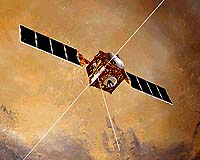
Since the last status report, the overall operational performance of the spacecraft and payload continued to be satisfactory. Some temporary problems were encountered with the Solid State Mass Memory (SSMM), which are currently under investigation.
Remaining payload-commissioning activities are being performed until mid-April. The MARSIS radar will be deployed on 20 April and subsequently the spacecraft will be fully commissioned.
Spacecraft resources, in particular power usage, are still constrained as Mars Express has encountered the first eclipse season, although the duration of eclipses per orbit is now slowly decreasing every day.
Scientific Payload Status
The status and performance of the orbiter payload in Mars orbit is excellent, with new high-resolution stereo and colour images and high-resolution spectral measurements of the planet being acquired, and further radio science data collected.
The orbit of the Mars Express spacecraft continues to be very stable. Imaging instruments and spectrometers have begun global coverage science data acquisition. In particular, HRSC and OMEGA have started to perform mosaic and map construction.
Since the last status report the following science material has been released:
PFS – Evidence of Methane Observations by the PFS instrument indicate that methane is present in the Martian atmosphere. The measurements so far suggest that the amount of methane present is about 10 parts per billion.
HRSC – Ascraeus Mons The image reveals formations associated with volcanic activity that have also been witnessed on Earth, and elsewhere in the Solar System. The lava tubes are caused by crusting which occurs over a lava channel, effectively turning it into a tunnel. If the tunnel empties of all its lava then it will collapse and leave depression on the planetary surface.
17 March 2004
