
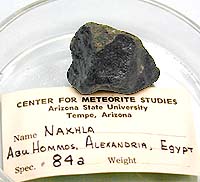
Thanks to NASA's unmanned planetary exploration program, evidence of the existence of past oceans on Mars has been accumulating for years, but no one had ever been able to say what the overall chemical composition of those oceans might actually have been like — until now.
A recent analysis of the interior of a 1.2 billion-year-old Martian meteorite known as the Nakhla Meteorite has shown the presence of water-soluble ions that are thought to have been deposited in cracks by evaporating brine, according to a study by Arizona State University Regents Professor of Chemistry and Geology Carleton Moore, Douglas Sawyer of Scottsdale Community College, ASU graduate student Michael McGehee and Julie Canepa of Los Alamos National Laboratory.
The finding, announced in the July issue of the journal Meteoritics and Planetary Science, indicates that ancient Martian oceans had a chemical composition similar in variety and concentration to Earth oceans.
"We have concluded that we have extracted salts that were originally present in Martian water," said Moore. "The salts we found mimic the salts in Earth's ocean fairly closely."
Moore, who is the director of the ASU Meteorite Center, decided to examine the ion content of Martian meteorites in ASU's sizable meteorite collection, when he noticed an oddity in chemical analyses done by Canepa, then a graduate student at ASU, 15 years ago.
