
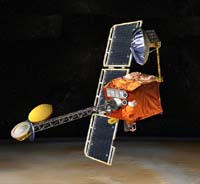
Like an answer to a prayer, NASA's Mars Odyssey spacecraft slipped into orbit around the red planet last night.
University of Arizona space scientists and students, their families and friends, and some of the taxpaying public gathered at the Lunar and Planetary Laboratory to see if Odyssey's main engine would fire to slow the spacecraft for capture into martian orbit.
Unofficially dubbed "Arizona Orbiter" for all the Arizona-built science gear it carries, the spacecraft did not disappoint. There was no flyby or crash landing.
At 8 p.m., what had been a lively program highlighting Mars exploration — and UA scientists and students can boast a big role in that enterprise — escalated into a champagne cork-popping party.
"Out of the delivery room and into the nursery," Steve Bougher saluted Gamma Ray Spectrometer (GRS) team leader Bill Boynton.
Boynton and his team of researchers and students built the GRS at the UA. It will for the first time map the amount and distribution of elements that make up the martian surface, including elements that indicate water, past or present.
Bougher, an LPL associate research scientist, and his graduate student, Paul Withers, this weekend begin around-the-clock shifts at their UA offices as part of the team working to "aerobrake" Odyssey into a circular orbit by mid-January.
