
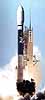
The Boeing Delta team will ring in the new year by launching the Mars Polar Lander and Deep Space 2 spacecraft for NASA from Complex 17B at Cape Canaveral, January 3, 1999. The launch window is at 3:21 p.m. EST.
The missions follow the Dec. 11 Delta launch, which sent NASA's Mars
Climate Orbiter on a 10-month journey to the Red Planet.
Over the years, Delta rockets have successfully placed into orbit an
impressive number of scientific payloads, sending planetary spacecraft
to the farthest reaches of our solar system.
The Mars Polar Lander and Deep Space 2 launch represent the 77th
scientific and technology development launch for the Delta family of
rockets. Since 1960 Delta rockets have carried scientific and technology
development payloads into space with a 98 percent launch success rate.
Delta rockets sent Mars Pathfinder and Mars Global Surveyor to the Red
Planet in 1996.
"This year, Boeing Delta rockets have lifted Deep Space 1 and Mars
Climate Orbiter into space as part of the NASA Medium-Light Expendable
Launch Vehicle Services program," said Darryl Van Dorn, Boeing director
of NASA and commercial programs. "Mars Polar Lander is the third in this
10-mission launch program for NASA," Van Dorn added. In addition, Delta
launch vehicles will carry the NASA spacecraft Stardust, Landsat-7, FUSE,
and EO-1/SAC-C into space next year.
Both the Mars Polar Lander and Deep Space 2 spacecraft will travel 11
months through deep space to land next December on an uncharted area near
the south pole of Mars.
Mars Polar Lander will spend three months digging for traces of water
beneath the frozen surface of Mars and will search for evidence of a
physical record of climate change. A miniature microphone will permit
scientists to record 10-second sound bytes of natural sounds from the
planet.
Deep Space 2 is comprised of two microprobes designed to penetrate the
surface of Mars and collect samples for testing the water vapor content
of the planet's subterranean soil. In addition, Deep Space 2 will validate the ability of small probes loaded with sensitive, miniaturized
instruments to analyze the terrain of planets and moons throughout the
solar system.
The missions are managed by the NASA Jet Propulsion Laboratory in
Pasadena, Calif. Lockheed Martin Astronautics, Denver, Colo., built
both spacecraft.
The Delta II is manufactured in Huntington Beach, Calif., with final
assembly in Pueblo, Colo., and is powered by the RS-27A engine built by Boeing in Canoga Park, Calif. The Delta launch team at Cape Canaveral Air Station will handle launch coordination and operations.
Alliant Techsystems, Magna, Utah, builds the graphite epoxy motors for
boost assist. Aerojet, Sacramento, Calif., manufactures the second-stage
engine; Cordant Technologies, Elkton, Md., supplies the upper-stage engine; and AlliedSignal, Teterboro, N.J., builds the guidance and flight control system.
Mars 98 Reports From Spacer.Com
