
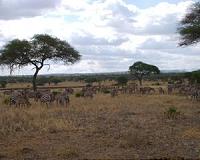
Scientists have quantified the ecological impact of mass wildebeest drownings in the Kenyan reach of the Mara River. Drowned wildebeest provide a dramatic boost to the Mara River ecosystem, they say.
"The Mara River intersects one of the largest overland migrations in the world," Amanda Subalusky, a postdoctoral researcher at the Cary Institute of Ecosystem Studies, said in a news release. "During peak migration, the wildebeest cross the Mara River multiple times, sometimes resulting in drownings of hundreds or thousands of wildebeest."
Researchers used field surveys to estimate the number of wildebeest who drown each year during river crossings. The data suggests roughly 6,200 wildebeest succumb to the raging waters each year.
"Our study is the first to quantify these mass drownings and study how they impact river life," said Subalusky, who conducted the research while at Yale University.
Subalusky and her colleagues tracked the fates of wildebeest carcasses by studying camera footage of scavengers and conducting stable isotope analyses of Mara River fish. Isotope analysis of bacteria, fungi and algae biofilms also helped scientists follow the trail of nutrients provided by decomposing wildebeest.
The annual influx of more than 1,100 tons of biomass is a boon to a variety of plant and animal species in the river.
"To put this in perspective, it's the equivalent of adding ten blue whale carcasses to the moderately-sized Mara River each year," said Emma Rosi, an aquatic ecologist at the Cary Institute. "This dramatic subsidy delivers terrestrial nitrogen, phosphorus and carbon to the river's food web."
While wildebeest flesh only provided sustenance for a few weeks, their bones can continue providing the ecosystem with valuable nutrients for several years.
"Mass drownings present a striking picture," said Rosi. "Rotting animal flesh spikes the aquatic ecosystem with nutrients. But once carcasses disappear, bones — which make up nearly half of biomass inputs — continue to feed the river."
Observations provided wildebeest flesh comprised nearly half the diet of common fish in the Mara River when carcasses were present. Biofilms growing on wildebeest bones also served as fish food. Scavenging bird species — including Marabou storks, white-backed vultures, Rüppell's vultures and hooded vultures — also feasted on wildebeest flesh. Surprisingly, just 2 percent of the wildebeest biomass ends up as crocodile food.
Researchers detailed their analysis of mass wildebeest drownings in the journal PNAS.
"The Mara River is one of the last places on Earth left to study how the drowning of large migratory animals influences aquatic ecosystems," said David Post, an aquatic ecologist at Yale University. "Many migratory herds, like bison, quagga, and springbok have been driven to extinction or remnant populations."
Mouse eyes react to light without the help of the brain
Washington (UPI) Jun 19, 2017 –
New analysis suggests the iris in the eye of a mouse doesn't need the brain's help to sense light and direct the pupils to dilate or contract in response.
Neuroscientists at Johns Hopkins Medicine severed the neural connection between brain and eyes in several mice specimens and then observed the behavior of the iris as the mice were moved from a dark room to a lit room. Despite the disconnection, the mice's pupils shrank as they transitioned into the light.
The findings — published in the journal Cell Biology — prove the pupillary light reflex works independently of the brain.
"The traditional view of this reflex is that light triggers nerve signals traveling from the eye's retina to the brain, thereby activating returning nerve signals, relayed by the neurotransmitter acetylcholine, that make the sphincter muscle contract and constrict the pupil," King-Wai Yau, a neuroscientist at John Hopkins, said in a news release.
Their latest research confirms previous studies, which showed the pupil sphincter muscle in mice, rabbits, cats and dogs functions without help from neural signals. The sphincter naturally reacts to light and releases melanopsin, a light-sensitive pigment.
In response to similar earlier findings, some researchers suggested the sphincter featured light-sensitive nerve fibers embedded directly in the muscle tissue, allowing the reflex to indirectly tap into neural circuitry and borrow the neurotransmitter acetylcholine.
But when researchers blocked acetylcholine in the most recent tests, mice pupils continued to contract without neural circuitry of any kind.
"The isolated iris sphincter muscle still contracted in response to light, adding confidence to the notion that the muscle is itself light-sensitive because it contains melanopsin," Yau said. "We thus have convincingly proven that the sphincter muscle is intrinsically light-sensitive, a very unusual property for muscle."
The research suggests this local function developed in primitive animals before the advanced evolution of the brain. Over time, the brain became involved in this reflex in most animals.
"By the time mammals appeared, the local reflex was progressively less important, becoming extinct altogether in subprimates that are active during the day and in primates," Yau said. "It's the local light reflex's absence in human beings that allows doctors to quickly evaluate whether a comatose patient is brain-dead by checking his or her pupillary light reflex."
Distantly related fish species still look and act similarly, study shows
Fish don't have to be closely related to be doppelgängers. New research out of Australia shows many distantly related fish species still look and act alike.
Scientists at James Cook University looked at anatomical and feeding patterns among a variety of fish species native to Australia. They discovery a surprisingly large number of commonalities.
"The study highlighted some real … read more
