
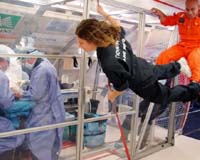
A U.S. study shows there's little difference in the dose of general anesthesia needed to knock out patients in weightless or normal gravity environments. The University of Florida researchers say their study is another step toward establishing proper medical protocols in space.
"There are lots of little technical things that have to be thought through and tried out in order to translate what we consider normal medical care into a space environment," said Assistant Professor Christoph Seubert. "What (anesthesia) you use and how the drugs react is only a small part of the picture."
On shorter missions to orbit the Earth or to travel to the International Space Station, astronauts could get back to the ground within a day if a medical emergency arose. But from Mars or even a lunar base, that's not possible, Seubert said.
French surgeons recently performed the first surgery in weightless conditions, operating during an airplane flight designed to mimic weightlessness. However, they used a local anesthetic and doctors still need to understand the effects of general anesthesia, the method of sedation used in most surgeries.
The UF study is detailed in the October issue of the Journal of Gravitational Physiology.
