
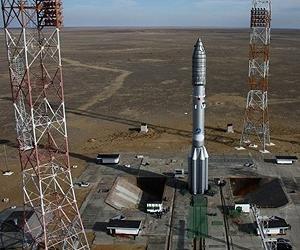
President Dmitry Medvedev on Wednesday fired two top space officials and reprimanded the head of Russia's space agency after the failed launch of three vital communications satellites, the Kremlin said.
Medvedev fired Vyacheslav Filin, vice president of the Energia Rocket and Space Corporation, and Viktor Remishevsky, the deputy head of Russia's Roskosmos space agency, news agencies quoted a Kremlin statement as saying.
The Russian president also reprimanded Roskosmos chief Anatoly Perminov, the statement added.
"On the Russian president's instructions, Roskosmos will undertake additional measures to strengthen its performance discipline," the Kremlin statement said.
A Russian Proton-M rocket failed to reach its initial orbit during the December 5 launch, causing it to dump the three high-tech Glonass-M satellites near the Hawaii Islands.
It marked an embarrassing setback to Russia's much-publicised attempts to introduce a global rival to the US Global Positioning System (GPS), a programme that was first begun by the Soviet Union in 1976.
earlier related report
Russia clears Proton launchers after grounding
Moscow (UPI) Dec 13, 2010 -Russia says it has cleared its Proton rockets for use after they were grounded last week following the loss of three satellites in a failed launch.
A government inquiry found the Dec. 5 failure was caused by over-fueling of a rocket's upper stage and not any design or technical issues, clearing the Proton class rocket to resume launches.
An investigated by a state commission of the failed launch, which resulted in the loss of three Russian Glonass navigation satellites, has cleared Proton's three lower stages from any involvement in the malfunction, Russian space officials said.
The Glonass launch used a new version of the Russian Block DM upper stage featuring larger propellant tanks.
Personnel fueling the upper stage for the launch did not account for the larger tanks and loaded between 2,200 pounds and 4,400 pounds more propellant than had been planned for the Glonass mission.
As a result of the excess propellant, the Proton's third stage, carrying excess weight, failed to place the satellites in orbit, and they crashed back into the Pacific Ocean.
Proton's next launch, set for the end of December, is a mission to lift a large commercial telecommunications satellite into orbit, officials said.
Share This Article With Planet Earth
