
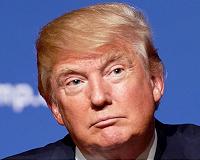
Here are a few key space issues that the new President must address. One of the most obvious issues and a large budget item is the International Space Station (ISS). NASA and its international ISS partners have pledged to support the program for seven more years.
The pressing issue here is whether to extend station operations beyond 2024, possibly until at least 2028. Beyond extending ISS's life, his other options are limited. One is to execute a controlled retro fire maneuver such that the 400,000-plus-kg monster reenters atmosphere and splashes into the Pacific Ocean. This action would be a shame, because the station was not completed until 2011 and it had a price tag of $100 billion.
Another possible scenario might be a conversion of the ISS into a commercial base for in-orbit manufacturing and other consumer activities. There surely must be an entrepreneur who can turn this financial behemoth into a commercial money-making queen. Mr. Trump will certainly soon be looking at the current $4 billion annual cost of ISS-related operations and wondering about its return on investment (ROI).
Another high-cost and complex issue deals with the future of the national security space infrastructure, i.e., disaggregation of the U.S. military satellite fleet. In recent months there have been proposals to phase out the use of expensive, monolithic military spacecraft and replace them with satellite constellations that are supposedly less vulnerable to enemy antisatellite weapons. Such constellations might be filled with many smaller satellites, rather than a few large and vulnerable platforms.
Yet another challenging issue is the question of whether the U.S. would benefit from joint space efforts with China. However, working with China in this arena has been a political taboo for the last 20 years. China is seen as a military adversary. It has antisatellite technologies, a very active military and industrial espionage program and violates our human rights standards.
Some would like to see a thaw in Sino-U.S. civil space relations. Some say we can learn from the Chinese. Others say joint activities with China will relieve the pressure on them to steal technology from us. Then, there is the military buildup in the South China Sea: not a good sign that they want to work together.
Of course, there are many other issues that are important, but have not yet become visible to the nation's leaders. Of these, there is one issue that is becoming a huge international challenge. The space debris population is growing at exponential rates in low earth orbits.
The pending addition of up to 12,000 new satellites in congested orbits will undoubtedly exacerbate the situation and possibly hasten a gridlock in the near-earth zone. All spacefaring nations may soon have to take action to control the debris buildup or suffer a "space lockout."
