
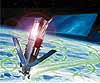
Today's successful launch of five Iridium satellites aboard a Delta II from Vandenberg Air Force Base, Calif., brings the Iridium system one step closer to being commercially available.
Motorola, inventor and prime contractor for the Iridium system, has set launch and satellite manufacturing industry records during the past 16 months in its quest to build and bring the first truly global, personal communications system to the world.
"What began as a vision more than a decade ago is nearing
reality," said Christopher Galvin, Motorola chief executive officer.
"This is about taking the next step in the evolution of wireless
communications. It's about harnessing the power of digital
technology…inventing and cultivating entirely new industries."
"When we first began this project in 1987, many people said it
couldn't be done," said Bary Bertiger, senior vice president and
general manager of the Motorola Satellite Communications Group. "We
are nearly complete on our field testing programs, have loaded all
necessary operational software onto all the satellites in orbit, and
are bringing all systems to final readiness."
Space Segment
Motorola has launched a total of 79 satellites for the Iridium
system since May 5, 1997. The initial deployment of 72 satellites on
15 launches was completed in 12 months, 12 days. The overall health of
the constellation remains good. The crosslinks on the Iridium
satellites have been tested and are working as expected.
These crosslinks are a unique feature that distinguish the
Iridium system from other planned satellite communications systems.
They enable the satellites to talk to one another in space, and
provide the ability to optimally route calls through the constellation
with the shortest delay.
"The satellite failures we have experienced over the past 15
months remain within our projections," said Bertiger. "In planning on
failures when we designed this system, we bought launch and on-orbit
insurance coverage." The failed satellites have been replaced on two
recent launches:
Two satellites on a Long March on Aug. 19
Five satellites on a Delta II on Sept. 8.
There are options for other maintenance launches this year and
throughout the duration of Motorola's five-year maintenance and
operations contract
"These recent launches have replenished two of the six orbital
planes in the constellation. The remaining four planes are also at
full operational capacity, with one possible exception," said
Bertiger.
SV14 in Plane 5 is experiencing communications difficulties. It
will be replaced by one of five new satellites to be put into orbit on
a Delta II maintenance launch that is planned for later next month.
The other four new satellites launched on that mission will serve as
spare satellites in orbit.
A malfunctioning or failed satellite would not have a major,
detrimental effect on the ability of the Iridium constellation to
provide global coverage. The crosslinking and dynamic routing among
the satellites, combined with the increasing overlap of their
"footprints" as they move away from the equator and approach the
poles, would minimize any potential loss of service.
"We have identified and corrected a software defect that we
believe was responsible for some of the satellite failures," Bertiger
said. "New satellites will be preloaded with all software before being
launched, and we anticipate this will eliminate the likelihood of this
type failure in the future."
Ground Segment
"The gateways are an integral part of the Iridium system,
providing the link from satellite to terrestrial communications," said
Rickie Currens, corporate vice president and general manager of the
Ground Systems Division.
"The Iridium North America Gateway, located in Tempe, Az., has
played a vital role in our field testing program over the past 3-4
months. During that time Motorola has made thousands of test phone
calls on the Iridium system. Voice quality on these test phone calls
has been described as 'excellent'."
The following gateways have been accepted for voice functionality
by the gateway owners and are planned to be operational when
commercial service becomes available. Those gateways are:
Iridium Eurasia – Moscow
Iridium India Telecom – Mumbai
Iridium Italia (Europe) – Rome
Iridium Korea – Seoul
Iridium Middle East/Africa – Jeddah, Saudi Arabia
Iridium North America – Arizona
Iridium North America – Hawaii
Iridium SudAmerica – Rio de Janeiro
Nippon Iridium Corp. (Japan) – Nagano
Pacific Iridium Telecom – Taipei
Thai Satellite Telecommunications – Bangkok
In addition, the following gateway is in its final acceptance
testing and should be ready for commercial service:
Iridium China – Beijing
Satellite Network Operations Center
The Satellite Network Operations Center, located in Landsdowne,
Va., near the Dulles International Airport, is the operational heart
of the Iridium system. From this new, state of the art facility, 250
Motorola engineers and operators man the satellite flight control
stations 24 hours a day, seven days a week.
There are two backup control facilities: one in Rome, Italy; the
other at the Motorola Satellite Communications Group headquarters in
Chandler, Ariz. The SATCOM facility served as the control center for
the first three Iridium missions until the Satellite Network
Operations Center became operational late last year.
"Motorola is controlling what we believe is the largest
commercial satellite constellation, and we are doing it with a degree
of efficiency unmatched anywhere," said Mark Borota, corporate vice
president and general manager of the Mobile Satellite Systems Division
which is responsible for the space and control segments of the Iridium
program.
Motorola is a global leader in software-energized wireless
communications, semiconductors, and advanced electronic systems and
services. Motorola creates cellular telephone, two-way radio, paging,
data and satellite communications systems and products that enable
people to take their worlds with them.
Motorola's embedded semiconductors are essential digital building
blocks for consumer, networking and computing, transportation and
wireless communications markets. Other businesses include automotive
electronics, components, computing and energy products. Sales in 1997
were $29.8 billion.
