
NASA has established a Web page for interested individuals to view Wednesday's total solar eclipse in real time and in safety.
This year's eclipse will be visible in South America, Africa and Asia, but NASA has partnered with the University of California, Berkeley, for a streaming Webcast, beginning at 5 a.m. Eastern Time, and a view of the totality – the phase of the eclipse where the Sun is completely blocked by the moon's shadow – starting at 5:55 a.m.
In addition to the Webcast, NASA will provide podcasts from Turkey starting March 27, and for the first time NASA and Libyan scientists will be conducting joint scientific activities to observe and study the event.
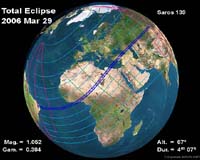
Total solar eclipses are rare sights because they require the Moon to be in its new phase, and its central umbra – the darkest shadow – to pass over the ground. In this Wednesday's case, the eclipse will be visible within a narrow corridor that crosses half of Earth. The path begins in Brazil and extends across the Atlantic Ocean, Northern Africa and Central Asia where it ends at sunset in Northern Mongolia.
Ground-based observers can see a partial eclipse within the much broader path of the Moon's penumbral shadow, which includes the northern two thirds of Africa, Europe, and Central Asia.
A total eclipse blocks out the entire central portion of the Sun. The sky darkens as though it is nighttime and – for the only time – reveals the Sun's corona, or outer atmosphere. Total solar eclipses are of special interest to astronomers because they represent the only time the corona can be studied.
Scientists still do not understand why the Sun's corona is so hot. Its temperature ranges from 1 million to 2 million degrees Fahrenheit, while the Sun's bright surface is only about 10,000 degrees. Careful measurements and experiments made during a total eclipse can help to unravel this enigma.
This year's eclipse is also special because the total phase will last over four minutes at the center of the path. Most total eclipses last only one or two minutes.
The next total eclipse, on Aug. 1, 2008, will be seen in northern Canada, Greenland, Siberia, Mongolia and northern China. It will last about two minutes. The next total eclipse visible from the United States will not occur Aug. 21, 2017.
