
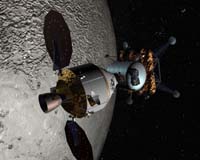
NASA has picked a group led by US aerospace giant Lockheed Martin Corp. to build a new spacecraft that will take astronauts back to the moon, the space agency said Thursday. "NASA selected on Wednesday Lockheed Martin Corp. … as the prime contractor to design, develop, and build Orion, America's spacecraft for a new generation of explorers," NASA said in a statement.
The National Aeronautics and Space Administration plans to have the Orion capsule ready for its first manned flight by 2014 and a moon mission no later than 2020. The agency also plans to use the capsule to eventually send humans to Mars.
Lockheed Martin beat out a group that included Northrop Grumman and Boeing for the multi-billion-dollar contract.
The capsule will replace the aging, three-shuttle fleet that is set to retire in 2010.
"Orion will be capable of transporting four crewmembers for lunar missions and later supporting crew transfers for Mars missions. Orion could also carry up to six crew members to and from the International Space Station," NASA said.
Orion's design is similar to the Apollo capsule that took Americans to the moon between 1969-1972.
NASA decided to retire its winged shuttle fleet by 2010 to meet President George W. Bush's vision for space exploration following the 2003 Columbia shuttle tragedy.
The winged shuttle is only designed for low Earth orbit missions.
NASA plans to send 16 shuttle missions to the International Space Station (ISS) over the next four years to complete construction of the half-finished orbiting laboratory.
The space agency hopes to launch the Atlantis shuttle by September 7 on the first ISS construction mission in nearly four years. Three launch attempts were canceled this week due to a lightning strike on the launch pad and Tropical Storm Ernsto.
The last two shuttle missions focused on improving flight safety following the Columbia tragedy.
NASA says Orion will be safer than the shuttle as the capsule will stand atop a rocket, reducing the risk of damage from debris during launch.
Columbia's left wing was struck by foam insulation that peeled off its massive external fuel tank during liftoff. The damage on the heat shield caused the shuttle to disintegrate as it re-ententered Earth's atmosphere with seven astronauts aboard.
