
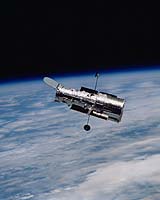
NASA announced Tuesday that its engineers are continuing to study the problem related to the Hubble Space Telescope's Advanced Camera for Surveys. Engineers first received indications on June 19 that the power supply voltages had fallen below acceptable operational limits, which caused the camera to switch automatically into a safe mode – and to stop operating.
The spacecraft's controllers at Goddard Space Flight Center in Greenbelt, Md., have taken the ACS offline entirely so they can work on the problem in relative safety and determine if a fix is possible.
Meanwhile, astronomers are continuing to use Hubble for observations via the other science instruments on board.
"We believe we are very close to fully understanding the issue experienced with the camera and we are going to resolve it," said Ed Ruitberg, deputy associate director of Goddard's astrophysics division. "However, before we proceed with any actions, we want to have a review board meeting to assess both the trouble-shooting and the proposed solution."
The board will meet at Goddard on Thursday to decide what to do next, although the engineers think they will be able to get the ACS to resume observations sometime early next month.
Hubble managers are planning a media teleconference Friday morning, at which they will disclose the results of the review board meeting.
The ACS is Hubble's most valuable instrument, not only because of its exquisite sensitivity, but also because the camera can detect images in a wide range of electromagnetic wavelengths, from far ultraviolet to infrared.
Installed aboard the orbiting telescope during a space shuttle servicing mission in 2002, the camera actually is a combination of three instruments, including a wide-field camera, high-resolution camera, and solar-blind camera.
The wide-field camera on the ACS can capture a panorama twice as wide as Hubble's Wide Field Planetary Camera 2. The high-resolution camera can take extremely detailed pictures of distant objects, such as the two newly discovered tiny moons of Pluto, which have just been named Nix and Hydra.
The solar-blind camera blocks visible light to enhance the telescope's sensitivity to UV light. The instrument specializes in detecting hot stars radiating in UV wavelengths.
The ACS was developed jointly by Goddard, Johns Hopkins University in Baltimore, Md., Ball Aerospace in Boulder, Colo., and the Space Telescope Science Institute in Baltimore.
