
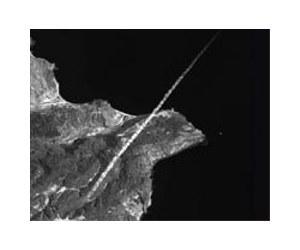
North Korea's rocket exploded mid-air before splashing down in the Yellow Sea off South Korea, Seoul's defence ministry said Friday.
"North Korea's rocket flew about one or two minutes before it exploded mid-air," the defence ministry said in a statement. "So the missile test is deemed to have failed."
The missile reached as high as 151 kilometres (94 miles) over South Korea's Baengnyeong island in the Yellow Sea near the inter-Korean sea border before it disintegrated into some 20 pieces.
The rocket started breaking up before it reached its maximum altitude, Major General Shin Won-Sik told journalists.
"As it was coming down to earth, it went through another explosion," he added.
Debris fell over a wide area, about 100 to 150 kilometres west of Pyeongtaek City, he said, adding no damage has been reported.
North Korea has said the rocket would place a satellite in orbit for peaceful research purposes, but Western critics see the launch as a thinly veiled ballistic missile test, banned by United Nations resolutions.
N.Korean launch was 'grave provocation': Japan
Tokyo (AFP) April 13, 2012 –
North Korea's rocket launch was a "grave provocation" that ran foul of numerous United Nations resolutions, Japan said Friday after Pyongyang's apparently unsuccessful blast off.
"Even if it was a failure, it is a grave provocation to our country and other countries concerned and violates UN Security Council resolutions," Chief Cabinet Secretary Osamu Fujimura said.
"We made strict protest through diplomatic channels."
North Korea launched a long-range rocket that appears to have disintegrated soon after blast off and fallen into the sea, South Korean and Japanese authorities said.
"We have not got the final confirmation that it was a missile," said Fujimura, "but at least we have the judgement that a flying object was launched and it failed."
The UN Security Council will hold an emergency session on Friday "to decide its next step" following the launch, a UN diplomat said.
North Korea has said the rocket would place a satellite in orbit for peaceful research purposes, but Western critics say the launch was a ruse for a ballistic missile test, banned by United Nations resolutions.
