
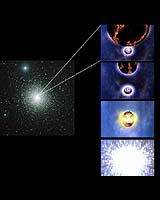
New research suggests that short gamma-ray bursts can be caused by the rematching of pairs of neutron stars.
Gamma-ray bursts are the most powerful explosions in the universe, emitting huge amounts of high-energy radiation. Though the phenomena have mystified scientists for a long time, recent studies have shown they seem to originate from two causes: from hypernovas-the explosions of giant stars-or from the collision of neutron stars, either with each other or with a black hole.
The new work, however-by Jonathan Grindlay of the Harvard-Smithsonian Center for Astrophysics, and colleagues Simon Portegies Zwart of the Astronomical Institute of The Netherlands and Stephen McMillan of Drexel University in Philadelphia-indicates that neutron star activity within globular clusters is another potential source of the titanic events.
"As many as one-third of all short gamma-ray bursts that we observe may
come from merging neutron stars in globular clusters," Grindlay said in a statement.
Globular clusters contain some of the oldest stars in the universe crammed into a tight space only a few light-years across. Such tight quarters can provoke many close encounters, some of which actually lead to partner swaps. If a neutron star with a companion, such as a white dwarf or Sun-sized star, exchanges its partner with another neutron star, the resulting pair eventually will spiral together and collide explosively, creating a GRB.
"We see these precursor systems, containing one neutron star in the form of
a millisecond pulsar, all over the place in globular clusters," Grindlay said. "Plus, globular clusters are so closely packed that you have a lot of interactions. It's a natural way to make double neutron-star systems."
GRBs occur in two forms: bursts lasting a minute or more, which seem to be caused by hypernovas, and short bursts, sometimes of only a millisecond, which probably originate from neutron-star merges.
Grindlay's team performed about 3 million computer simulations to calculate the frequency with which double neutron-star systems can form in globular clusters. Knowing how many have formed over the galaxy's history, and approximately how long it takes for a system to merge, they then determined the frequency of short gamma-ray bursts expected from globular cluster binaries. They estimate between 10 and 30 percent of all short gamma-ray bursts may result from such systems.
