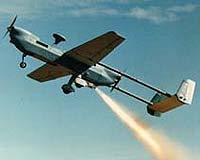
Northrop Grumman has successfully completed the first phase of flight testing a demonstrator version of a new medium altitude endurance unmanned aerial vehicle (UAV) it plans to offer U.S. military and homeland defense customers.
The company-funded flights of the Hunter II prototype were conducted Dec. 27 – Jan. 12 at Cochise College Air Field in Douglas, Ariz. Designed to demonstrate the UAV's endurance, communications and air-to-ground surveillance capabilities, the flights are part of the company's ongoing effort to enhance the U.S. Army's warfighting capabilities using autonomous unmanned air systems.
"Hunter II builds upon the combat-proven Hunter system that has gained a stellar reputation for reliability and durability," said Rick Crooks, Northrop Grumman's manager of business development for tactical UAV systems.
"In addition to offering extended range and endurance capabilities, it will feature a software architecture that can easily accommodate new payloads and data handling requirements; state-of-the-art avionics; a weapons capability and communications subsystem that will allow it to share data seamlessly with current battlefield networks."
"Hunter II's high commonality with the current Hunter system will also allow it to exploit and work easily with current U.S. Army equipment, soldier training systems and logistics infrastructure," added Crooks.
The twin-boom Hunter II, an enlarged version of the combat-proven Hunter UAV, will offer customers a "medium-range, medium-altitude" system to complement the company's current high-altitude, long-endurance RQ-4 Global Hawk aerial reconnaissance system; its shorter-range, lower-altitude RQ-5A Hunter tactical UAV and its Fire Scout vertical take-off and landing tactical UAV.
It will also take advantage of past and current U.S. Department of Defense investments in those and other UAV systems such as DARPA's Joint Unmanned Combat Air Systems and the Army's Fire Scout Class IV UAV for its Future Combat Systems.
The company plans to conduct additional test flights of the Hunter II demonstrator through the first quarter of 2005. Those flights will be used to integrate and characterize the performance of additional payloads.