
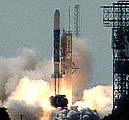
OrbComm Global the first provider of commercial global low-Earth orbit (LEO) satellite data and messaging communications services, today announced that its Network Control Center has established ground communication with seven of the eight low-Earth orbit (LEO) satellites launched from NASA's Wallops Island Flight Facility on December 23. Efforts to communicate with the remaining satellite are underway. The average orbit of the satellites is reported to be a near-perfect 816 by 824 kilometers.
Orbital Sciences Corporation's L-1011 carrier aircraft with the
Pegasus(r) XL rocket took off on Tuesday, December 23, from NASA's
Wallops Island Flight Facility in Virginia at 1:13 p.m. (EST). The
aircraft flew approximately 60 miles off the Virginia coast to a
predetermined point 39,000 feet over the Atlantic Ocean, where the
Pegasus rocket was released at 2:11 p.m. (EST). After a 72-minute
flight, the eight OrbComm satellites were injected into their target
orbit. Within hours, initial communications with the new satellites
had begun. OrbComm's newly launched satellites are currently undergoing
a three-month testing and deployment phase.
“We are pleased to have established ground communications with
seven of the satellites and are working to communicate with the
eighth,'' said Alan Parker, OrbComm president and CEO. “In addition,
one of the satellites is generating reduced power, the cause and
effects of which are currently under evaluation. We are ahead of
schedule in our evaluations and testing of the satellites and will
continue to complete further testing. We are preparing to launch the
next 18 satellites in our constellation by the middle of 1998, and are
eager to bring the innovative concept of real-time global data and
messaging to businesses and consumers worldwide.''
OrbComm is a mobile satellite service provider offering
high-value, two-way data and messaging communications globally through
international service licensees and in the U.S. through value-added
resellers and direct sales. OrbComm applications include monitoring of
industrial assets such as pipelines, storage tanks, and construction
equipment; tracking of mobile assets such as trailers, railcars and
shipping containers; and two-way message communications in the
recreational, commercial, military and automotive markets.
