
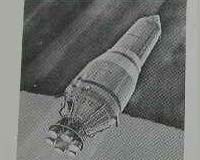
An old U.S. Air Force spy satellite named Hitch Hiker 1 passed close but harmlessly by the International Space Station, a top ballistics expert with Russia's mission control center told the RIA Novosti news service Tuesday.
Hitch Hiker 1, launched aboard a Thor-Agena D rocket from Vandenberg Air Force Base, Calif., on June 27, 1963, closed within 1,000 feet of the space station at a combined speed of more than 32,000 miles (52,000 kilometers) an hour.
Hitch Hiker, whose mission remains classified, was thought to be designed to detect Soviet Union nuclear weapons tests from its polar orbit.
"Our calculations have been correct – the object flew past the station," Nikolai Ivanov told the news service, adding the ISS crew had not been instructed to try to photograph Hitch Hiker, because it was moving at such a high speed.
"The speed was more than 14 kilometers (9 miles) per second, and it was impossible to record it," Ivanov said. He noted that the U.S. Space Catalog contains more than 10,000 various objects of different sizes currently in orbit around Earth – including the space station.
"Only 10 percent of these objects, each of which has a number, are operable spacecraft, and the rest are just space garbage," Ivanov said.
He added, however, that if mission controllers' calculations had been incorrect, the satellite could have pierced or several damaged the station. He said Russian and NASA systems had been monitoring the encounter.
"The ISS had a special procedure, developed in advance, for emergency maneuvers to swerve away from space garbage," Ivanov said. "The ISS has used six such maneuvers in its history – four with the help of Progress spacecraft and two using shuttles."
