
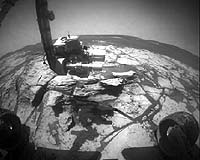
Opportunity has positioned itself at an exposed rock outcrop and is in the middle of an "in situ" (contact) science campaign with the robotic arm (IDD). Because of the project team's desire to rest the right-front wheel actuator and to limit driving while an earlier drive sequence error is remedied, Opportunity took advantage of the nearby rock outcrop.
This fits with the strategic science campaign to periodically stop and "taste" the geology along the route to Endeavour crater.
Part of the rim of Endeavour can now be seen on the distant horizon.
On Sol 1824 (March 11, 2009), Opportunity drove about 5 meters (16 feet) to the exposed rock outcrop. The rover bumped (fined tuned its location) only about half a meter (1.5 feet) on the next sol to reach a position where surface targets are within the reach of the IDD.
Because of the degraded IDD Joint 1 (shoulder azimuth), positioning the IDD has become more challenging, but it was accomplished successfully.
On Sol 1826 (March 13, 2009), Opportunity began the IDD work, first with a Mossbauer spectrometer (MB) touch, then with a microscopic imager (MI) mosaic.
On Sol 1829 (March 17, 2009), additional MI mosaics were collected, followed by the placement of the MB for several sols. Additional ground testing was completed to prepare for the first use of the rock abrasion tool (RAT) since the earlier failure of another of its encoders.
As of Sol 1831 (March 19, 2009), Opportunity's solar array energy production has dipped to 391 watt-hours in connection with atmospheric opacity (tau) increasing to 0.934. The dust factor on the solar array is 0. 533. The rover is in good health. Opportunity's total odometry is 15,051.41 meters (9.35 miles).
Share This Article With Planet Earth
