
NASA's second Mars Exploration Rover passed the first anniversary of its mission to the red planet on Monday. Opportunity, which landed close to the Martian equator Jan. 24, 2004, in an iron-oxide-rich area called Meridiani Planum, eventually discovered rock samples that provided the first chemical evidence liquid water once flowed on Mars.
Soon after its landing last year, Opportunity relayed images and other data via NASA's Mars Odyssey orbiter, showing the spacecraft was healthy and ready to begin its mission, which controllers originally had estimated at 90 Martian days, or sols.
"Opportunity has touched down in a bizarre, alien landscape," Steve Squyres of Cornell University, the principal investigator for the science instruments aboard both Opportunity and its twin, Spirit, said at the time. "I'm flabbergasted. I'm astonished. I'm blown away."
Opportunity discovered rocks containing hematite, an iron-rich compound that forms almost always only in the presence of water. The rover also found other salty compounds on the Martian surface that indicated a once-wet environment.
Though mission controllers at NASA's Jet Propulsion Laboratory declined to predict how much longer Opportunity will continue to function, they said the golf-cart-sized rover's prognosis was excellent.
After a year of operations, its solar panels are still putting out nearly 90 percent of their peak-level power. The dreaded Martian dust has failed to degrade them as much as expected.
Keeping Track Of MER-B
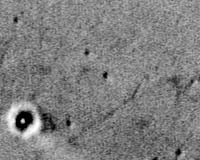
This enhanced-resolution image from the Mars Orbiter Camera on NASA's Mars Global Surveyor orbiter is the only picture obtained thus far (by Jan. 24, 2005) that shows the tracks made by Opportunity.
The image was acquired on April 26, 2004, during Opportunity's 91st martian day, or sol. That was the first day of Opportunity's extended mission, and the rover had recently completed exploration of small "Fram Crater" on the route from its landing site toward "Endurance Crater," where it would eventually spend six months.
The rover itself can be seen in this image — an amazing accomplishment, considering that the orbiter was nearly 400 kilometers (nearly 250 miles) away at the time! Also visible and labeled on this image are the spacecraft's lander, backshell, parachute and heat shield, plus effects of its landing rockets.
The camera captured this image with use of a technique called compensated pitch and roll targeted observation. In this method, the entire spacecraft rolls as it passes over the target area so the camera can scan in a way that sees details at three times higher resolution than the camera's normal high-resolution capability.
The tracks made by Opportunity on the sandy surface of Meridiani Planum are not quite as visible from orbit as are the tracks made in Gusev Crater by the other Mars Exploration Rover, Spirit. A dustier surface at the Spirit site increases contrast between the tracks and the surrounding surfaces.
Indeed, some parts of the track made by Opportunity are not visible in this image. Sunlight illuminates the scene from the left. North is toward the top of the image. The 100-meter scale bar is 109 yards long.
