
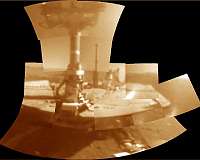
The dust storm on Mars is now a Planet-encircling Dust Event (PEDE).
It shows no indication of receding at this time. Since the last contact with the rover on Sol 5111 (June 10, 2018), it is likely that Opportunity has experienced a low-power fault, putting herself to sleep only to wake when the skies eventually clear.
If the atmospheric opacity or the solar array dust factor has gotten worse since the last telemetry, Opportunity could also experience a mission clock fault.
A clock fault will complicate the recovery, but not prevent it. An analysis of the rover's long-term temperature trends, conservatively assuming no solar array input, indicates that the rover's electronics and batteries will stay above their flight-allowable temperatures. There is a small concern with the health of the batteries if they discharge completely. The batteries might loose some of their capacity if the cell voltages drop to near zero.
The project is listening every day for the rover during both the time of low-power fault communication windows and listening over a broader range of times under mission clock fault.
Additionally, for the near term, the project is also sending a command to elicit a beep if the rover happens to be awake. The Deep Space Network (DSN) Radio Science Receiver (RSR) team is using the RSR to listen in on any DSN pass pointed at Mars that corresponds to possible wake up times for the rover.
The plan is to continue this every day while waiting for the skies to clear. The team does not expect to hear anything from Opportunity until there has been a significant reduction in the storm and the associated atmospheric opacity over the rover site.
