
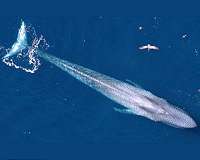
The disappearance of terrestrial megafauna — like wooly mammoths and saber tooth tigers — during the last ice age is well documented. Now, scientists have found evidence that marine megafauna also suffered a previously unknown extinction event.
Paleontologists at the University of Zurich analyzed marine fossils dated to the Pliocene and Pleistocene epochs, from 5.3 million to 9,700 years BC.
"We were able to show that around a third of marine megafauna disappeared about three to two million years ago," lead researcher Catalina Pimiento, a scientists with Zurich's Paleontological Institute and Museum, said in a news release. "Therefore, the marine megafaunal communities that humans inherited were already altered and functioning at a diminished diversity."
Fossil analysis showed the extinction even resulted in a 55 percent reduction in biodiversity. The number of turtle species declined 43 percent. Bird biodiversity declined 35 percent, and shark biodiversity declined 9 percent.
Researchers attempted to quantify the extinction event's effects on coastal ecosystems by analyzing the loss of seven functional entities, groups of animals that share similar functional roles in a local ecosystem.
The significant loss of functional entities within coastal ecosystems proved disruptive, forcing surviving marine animals to adjust. Violent sea level fluctuations made adaptation difficult. Ecological balance was further damaged by rapidly changing oceanographic characteristics, including shifting sea currents.
Researchers published their new analysis this week in the journal Nature Ecology and Evolution.
"Our models have demonstrated that warm-blooded animals in particular were more likely to become extinct. For example, species of sea cows and baleen whales, as well as the giant shark Carcharocles megalodon disappeared," said Pimiento. "This study shows that marine megafauna were far more vulnerable to global environmental changes in the recent geological past than had previously been assumed."
Volcanic eruptions triggered dawn of the dinosaurs
Huge pulses of volcanic activity are likely to have played a key role in triggering the end Triassic mass extinction, which set the scene for the rise and age of the dinosaurs, new Oxford University research has found. The Triassic extinction took place approximately 200 million years ago, and was proceeded by the dinosaur era. One of the largest mass extinctions of animal life on record, the ca … read more
