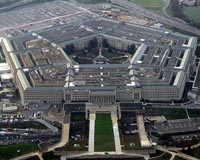
The Pentagon said Thursday it has established a new body to support President Donald Trump's order to send the military to the southern border, but questions remain about what the deployment will actually look like.
The so-called "border security support cell" will channel information between the Pentagon and the Department of Homeland Security, which is responsible for border security.
"The cell will last for the foreseeable future, to ensure we surge our capacity to meet the president's enhanced border security goals," Pentagon spokeswoman Dana White told reporters.
Trump on Wednesday ordered the National Guard to deploy to the southern US border, ratcheting up pressure on Mexico and taking another step in his quest to clamp down on illegal immigration.
Because the National Guard falls under the purview of state governors, the Pentagon needs to liaise with each of the four states bordering Mexico to determine how the military will operate.
"The National Guard's efforts will include aviation, engineering, surveillance, communications, vehicle maintenance and logistical support," White said.
But Pentagon officials still do not know how many troops will be on the border, whether they will be armed, when they will deploy and how long they will be there.
Pentagon planners have been scrambling to find ways to support Trump's surprise edict that he would send the military to the border.
The commander-in-chief's seemingly off-the-cuff directive blindsided officials Tuesday, when Trump said the military would guard the frontier until "we can have a wall and proper security."
White denied there was a lack of coordination or communication between Trump and the Pentagon.
"The communication between the White House and the Defense Department is very clear," she said.
Trump wants to build a wall along part of the Mexican border, but his pet project is facing financial hurdles and he has suggested poaching Pentagon cash to help pay for it.
White said the Defense Department is looking into building a stretch of wall at its Barry M. Goldwater Air Force Range in Arizona, where it abuts the border.
'Threats, disrespect' unjustified, Mexican president tells Trump
Mexico City (AFP) April 5, 2018 –
Mexican President Enrique Pena Nieto lashed out at his US counterpart Donald Trump on Thursday amid growing tensions over migration and border security, saying "threatening or disrespectful attitudes" were unjustified.
Speaking after Trump ordered National Guard troops to secure the US-Mexican border, Pena Nieto vowed Mexico would stand up for itself and suggested the American president was jeopardizing the two countries' relationship for domestic political gain.
"If your recent statements are the result of frustration due to domestic policy issues, to your laws or to your Congress, it is to them that you should turn, not to Mexicans. We will not allow negative rhetoric to define our actions," he said in a national address.
US-Mexican ties have been strained since Trump won office on the back of a campaign heavy on anti-Mexican rhetoric.
Pena Nieto has twice canceled plans to visit Washington after tense phone calls with Trump in which the Republican president refused to back down from his insistence that Mexico pay for his planned border wall.
Trump's latest attacks on Mexico were triggered by news reports on a caravan of Central American migrants crossing the country toward the United States.
The caravan, which numbered more than 1,000 Hondurans, Salvadorans and Nicaraguans, began breaking up Thursday, after the activists organizing it said it had abandoned its goal of reaching the US border and would end its activities with a rally in Mexico City.
The decision came after four straight days of Twitter diatribes from Trump.
The US president ordered thousands of National Guardsmen to secure the border and threatened to ax what he called Mexico's "cash cow," the North American Free Trade Agreement (NAFTA), if the Mexican authorities did not stop the migrants.
The ongoing talks on modernizing NAFTA have also strained ties between the two countries, as well as Canada, the third member of the agreement — though the three countries have recently indicated they are close to reaching a new deal.
"We are convinced that, by coming to agreements as friends, partners and good neighbors, both countries will fare better than if we confront each other," Pena Nieto said.
"We stand ready to negotiate, certainly, but always based on mutual respect."