
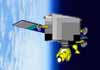
A joint TRW and Raytheon team has won a $275 million contract from the US Air Force for the Program Definition Risk Reduction (PDRR) phase of the Space-Based Infrared System Low (SBIRS Low) program, the low-Earth orbiting component of the nation's next-generation, ballistic missile early-warning system.
The TRW/Raytheon team was one of two contractor teams selected to define program requirements and complete conceptual designs for an operational SBIRS Low system under a 38-month contract. Included in PDRR is a comprehensive ground demonstration designed to reduce the risk and verify the performance of an operational system.
The TRW/Raytheon team also includes Motorola, Hewlett-Packard, Honeywell, Ball Aerospace & Technologies, Sparta and PRA.
"SBIRS Low is an extremely key program for us, and we're very pleased to have been chosen to proceed to the next phase of its development," said Tim Hannemann, executive vice president and general manager, TRW Space & Electronics Group (S&EG). "We have the right team, experienced people, and the resources to develop an affordable, producible design that satisfies the nation's needs at a low cost."
"SBIRS Low will provide a significant capability for national defense, and we are proud to be a part of the integrated Air Force and contractor team that will define and develop a payload to meet these critical mission requirements," said Christine Davis, executive vice president and general manager of Raytheon's Sensors and Electronic Systems business segment. "Our plan includes a focus on design and cost trade studies, and on risk reduction efforts to ensure the success of this program."
Heading the program at TRW is Patrick Caruana, vice president and program manager, SBIRS Low. Prior to joining TRW in 1997, Caruana spent 36 years as a member of the Air Force, serving in a full range of leadership and staff positions and achieving the rank of Lieutenant General. In his last position, Caruana served as the vice-commander of Air Force Space Command, Peterson Air Force Base, Colorado.
TRW and Raytheon have dedicated more than 15 years to the SBIRS Low mission. The team's approach to the ground demonstration will maximize the use of previous efforts and existing software, hardware, models, simulations and data.
TRW is renowned for its long-standing expertise in the design, development and integration of complex defense space systems and as a Total System Performance Responsibility provider. Raytheon is a leader in developing missile defense systems, with a heritage of successful programs for space surveillance and missile early warning. The company is currently developing key technologies needed for National Missile Defense and Theater Missile Defense.
Following completion of PDRR, the USAF is expected to select a single contractor to build the multi-satellite SBIRS Low constellation, estimated to cost several billion dollars over its lifetime. Initial launches are planned for the middle of the next decade.
SBIRS Low is a component of the SBIRS system, which also includes satellites in geosynchronous orbits, sensors hosted on satellites in highly elliptical orbit, and ground data processing and control systems. SBIRS incorporates new technologies to enhance detection and improve the reporting of ballistic missile launches.
SBIRS will integrate with, and eventually replace, the existing Defense Support Program (DSP) ballistic missile early-warning system. TRW has built and integrated all 23 DSP satellites.
