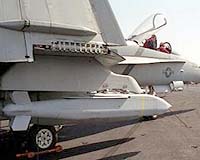
Raytheon has received the first contract for international sale of its Joint Standoff Weapon (JSOW) to Turkey for integration on its F-16 aircraft. Raytheon received a foreign military sales contract from the Naval Air Systems Command for procurement of JSOW AGM-154 A-1 with the BLU-111 warhead and JSOW AGM-154 C with the Broach warhead.
A foreign military sales contract for JSOW-C integration for Poland F-16s was awarded in 2003, and Poland's procurement of the system is expected next year. In addition, letters of agreement for JSOW integration with Greek F-16s and Singapore F-15s have been signed by the U.S. government. These contracts are expected to be awarded soon. Future JSOW missile procurement for these countries is planned.
"We are seeing an increased international interest in JSOW procurement because it offers a very cost effective solution for mid-range standoff weapons. JSOW has a maximum kinematic range of 70 nautical miles (130 kilometers) and is an extremely survivable weapon against defended targets," said Capt. David Dunaway, the Navy's JSOW program manager.
Raytheon is under contract with the Navy to provide JSOW to the U.S. Navy, Marine Corps and Air Force. JSOW deliveries started in 1997 with the first low-rate initial production delivery to the U.S. Navy.
Development of a Block III variant of JSOW has started, which will add moving target capability by adding a weapons data link and other improvements.
"This will give our warfighters a network capable weapon, which greatly increases their capability to engage moving land and sea targets at standoff range," said Ron Shields, Raytheon's JSOW program director. The first Block III weapon is scheduled to be produced in 2009.
JSOW was a 2005 winner of the Department of Defense David Packard award for Excellence in Acquisition for Block II cost reduction initiatives.