
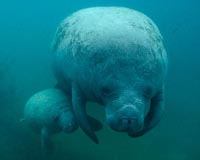
Researchers said 2005 was the second-deadliest year on record for Florida's endangered manatees, with toxins produced by red tide blooms from the alga Karenia brevis, an event occurring more and more frequently in the state – and new studies show those same toxins are endangering the human population as well.
"It appears that these red tide events are increasing in nature, especially on Florida's west coast," said marine-mammal researcher Gregory Bossart, who directs the Harbor Branch Oceanographic Institution's marine-mammal research. "I think that manatees and other animals impacted by these events are sentinels for serious environmental and human problems, and in fact our research makes a strong case for potentially severe human red-tide impacts."
Bossart and colleagues presented their findings at the American Association for the Advancement of Science annual meeting.
Hoping to determine if brevetoxins are threatening humans in the same way they can harm manatees, Bossart and researchers from four other U.S. institutions began studying the problem in 2000. For some time, scientists have known about the human threats posed by brevetoxin-tainted shellfish, which can cause neurotoxic shellfish poisoning, but Bossart's team focused on the impacts of brevetoxin inhalation on humans, something far less understood.
As one component of the work, they reviewed records from the Florida Department of Health that showed the number of people in affected areas admitted to emergency rooms with respiratory problems such as bronchitis, or asthma flare ups, sharply increases during red tide blooms.
"What's disturbing," Bossart said, "is that humans appear to respond to prolonged brevetoxin exposure in a way similar to manatees that die from it."
In mouse experiments, they found the brevetoxins suppressed mouse immune systems. If the toxins also suppress human and manatee disease immunity – as Bossart thinks is likely – the finding could link those exposed to brevetoxins to ailments not currently associated with the red tides. This would pose a serious problem to residents of southwest Florida, where red-tide events have been most severe, and to a lesser extent to people living at other areas around the Gulf of Mexico and Florida's Atlantic coast, where red tides also occur.
Bossart said increasing brevetoxin woes for both manatees and humans are examples of a problem he calls "environmental distress syndrome." That is, ecological and other changes associated with human activities are expanding the reach of existing disease threats in the marine environment, and they are enabling the emergence of new disease-causing agents.
The researchers recently documented a number of new viruses in dolphins and other marine mammals, and they suspect marine mammals might become increasingly susceptible to these emerging and existing diseases as a result of poor environmental conditions causing degraded immune systems, among other effects.
The cause of red-tide events remains undetermined, but some scientists suspect they are a result of human activities, such as nutrient pollution through runoff and other problems that may fuel red tide growth.
In earlier research, Bossart and colleagues developed the first sensitive test for the presence of brevetoxins in manatee tissue. This was considered a key advancement, because positive determination of the toxin's presence had remained elusive. Relying partially on that test, an interdisciplinary group of researchers discovered recently that manatees could be killed not only by inhaling brevetoxins during a red tide bloom, but also by brevetoxins sequestered in seagrasses eaten long after a bloom has dissipated.
The results, published in the journal Nature in 2005, further strengthen the human-manatee tie on brevetoxin effects, as humans also face serious health threats from brevetoxins sequestered in seafood.
