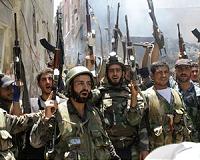
Russian-backed regime forces seized several towns and villages in northwest Syria Thursday, as deadly air strikes hit the jihadist-held bastion, a monitor said.
Seven civilians died in air strikes in the south of the stronghold, the Syrian Observatory for Human Rights said, a day after regime air strikes killed 12 others — including six children — in a town.
Eight years into Syria's war, the Idlib region of some three million people is one of the last holdouts of opposition to President Bashar al-Assad's regime.
His forces have been chipping away at the southern edge of the stronghold run by Syria's former Al-Qaeda affiliate for three weeks, after months of deadly bombardment.
Last week, the regime took control of Khan Sheikhun, a town on a key highway that runs through Idlib province, linking Damascus to second city Aleppo.
Overnight, pro-government fighters "managed to advance in the southern Idlib countryside", according to the head of the Britain-based Observatory, Rami Abdel Rahman.
They took control of the towns of Al-Tamaanah and Al-Khuwayn, as well as nearby villages, east of Khan Sheikhun, he said.
"The forces are trying to further extend their control in the area of Khan Sheikhun before they advance north in the direction of the town of Maaret al-Noman," he added.
Maaret al-Noman is the next stop northwards on the Damascus-Aleppo highway.
– Children killed –
Regime air strikes killed 12 civilians — half of them children — in Maaret al-Noman on Wednesday.
AFP photographers at the scene saw rescue teams working to pull people from the rubble after nightfall with the help of bright spotlights.
A rescue worker pulled the body of a young girl from the debris, her lifeless form covered in white dust.
Her bloodied head and little arm hung limp as he carried her in his arms to an ambulance.
Inside a morgue, a young father sobbed over the bodies of his three children and their cousin, none of whom appeared older than five.
Also on Wednesday, another four civilians, including one child, were killed in other parts of the jihadist-held bastion.
Increased bombardment by the Syrian military and Russia since late April has killed more than 950 civilians in Idlib.
In the same period, the violence has displaced more than 400,000 people including many already uprooted from other areas, the United Nations says.
On Thursday, UN envoy Geir Pedersen called for an end to operations that are "killing and displacing" civilians in Idlib.
"No one pretends that there is any easy solution to the challenge of countering" jihadist group Hayat Tahrir al-Sham, he told the Security Council.
"But counter-terrorism cannot put three million civilians at risk."
The bombardment and ground offensive come despite a deal between Russia and rebel backer Turkey in September last year to protect the area with a planned buffer zone.
That security cordon was never fully implemented, but Turkish troops deployed to 12 monitoring points around the planned buffer.
On Wednesday, the Observatory said air raids hit near one of the monitoring points in Sheir Maghar.
Turkey's state-run Anadolu news agency said the post itself was not hit.
Syria's war has killed more than 370,000 people and displaced millions more since it started in 2011 with the brutal repression of anti-government protests.
Israel says Iran seeking to build precision missiles in Lebanon
Jerusalem (AFP) Aug 29, 2019 –
The Israeli army on Thursday accused Iran of collaborating with Lebanon's Hezbollah to assemble precision-guided missiles that could cause "massive" human casualties in Israel.
Tehran and the Shiite movement plan to convert "stupid rockets into precision-guided missiles", Israeli army spokesman Jonathan Conricus told journalists in a conference call.
He said Iran had tried between 2013 and 2015 to transport precision-guided missiles to Hezbollah through war-torn Syria, where both back the Damascus regime.
But that strategy failed due to "Israeli operations", said the army, without elaborating.
Israel has carried out hundreds of strikes in Syria against what it says are Iranian and Hezbollah targets.
Conricus said that in 2016, "Iran and Hezbollah changed their strategy… (to one of converting) existing rockets into precision-guided" projectiles.
He accused Tehran of planning to smuggle in the required components.
Conricus estimated that Hezbollah currently has some 130,000 rockets, an arsenal he said does not by itself amount to "accurate" weaponry, even if such projectiles constitute a "threat".
"However if they are able to produce a precision-guided arsenal… that will create a different and much more dangerous situation," he added.
Conricus accused Hezbollah of being "willing to strike civilians and strategic facilities… in order to create a massive amount of casualties and damage in Israel".
"Hezbollah does not yet have an industrial capability to manufacture precision guided missiles" but continues to work towards that goal, he added.
The allegations come after Hezbollah — with which Israel has fought several wars — accused the Jewish state of carrying out a drone attack Sunday on its Beirut stronghold.
Israel's military did not confirm whether it was behind the weekend attack, which saw one drone explode and another crash without detonating.
The Shiite movement's chief Hassan Nasrallah said Sunday that an armed drone had "hit a specific area," without elaborating.
According to the UK's Times newspaper, the drones fell near Iranian installations manufacturing a fuel used by precision missiles.
The Beirut attack came after Israel on Saturday launched strikes in neighbouring Syria, saying it was to prevent an Iranian attack on the Jewish state.
– 'Be warned' –
The Israeli army said that Mohammed Hussein-Zada Jejazi — head of the Lebanese branch of the Quds Force — was the mastermind of the alleged Iranian-Hezbollah missile plot.
The Quds Force is an elite organisation that runs the external operations of Iran's Revolutionary Guards.
The Israeli army also released a photo that it said showed Jejazi.
It accused Lebanese citizen Fouad Shokr — a high-ranking Hezbollah commander — and two other Iranians, Majid Nua and Ali Asrar Nuruzi, of also being involved.
Israel's military said Majid Nua was an engineer with specialist knowledge of surface-to-surface missiles.
Netanyahu on Thursday said Israel was "determined to stop our enemies from possessing destructive arms."
"Today I tell them: 'dirbalak'," he said — Arabic for "be careful".