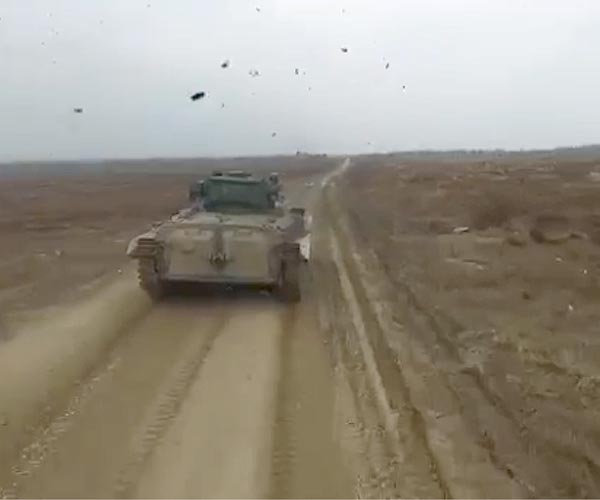
Russia on Friday began withdrawing its armed forces that had been on manoeuvres near the borders of Ukraine following weeks of heightened tensions between Moscow and the West over the troop build-up.
The deployment, which came amid an increase in fighting between Kiev's forces and pro-Russia eastern separatists since the start of the year, raised deep concerns in Ukraine and drew warnings to Moscow from Western allies.
Moscow said Thursday that tens of thousands of troops deployed to southern and western Russia for exercises in recent weeks would be returning to their bases.
The defence ministry confirmed the withdrawal Friday.
"Military units and formations are currently marching to the coast, railway loading stations and airfields, and loading onto landing ships, railway platforms and military transport aircraft," a statement said.
Kiev's Foreign Minister Dmytro Kuleba greeted the news with cautious optimism, saying the drawdown would help to ease tensions.
But he warned that "this step in and of itself does not halt the escalation or the conflict as a whole".
"Ukraine calls on its partners to remain vigilant for now, to continue to monitor the situation closely and to take effective measures to contain Russia," he said in a statement.
Kiev had earlier welcomed Russia's announcement, with Ukrainian President Volodymyr Zelensky saying the move "proportionally reduces tension".
A NATO official said Thursday that any "de-escalation by Russia" is important, while the United States had said it was "looking for action" on the troop withdrawal.
The Kremlin on Friday dismissed concerns over the exercises and said Russian President Vladimir Putin was ready to improve ties with Western leaders, so long as the intention was mutual.
"The movement of Russian troops within Russia is not a threat to anyone," spokesman Dmitry Peskov told reporters.
Putin has "repeatedly said that we are interested in improving and restoring relations with the United States", Peskov added.
The Kremlin's pointman on relations with Ukraine and pro-Russia separatists, Dmitry Kozak, later on Friday offered negotiations with mediators from Paris, Berlin and Kiev in eastern Ukraine in the coming days.
Together with Russia, France, Germany and Ukraine form the Normandy format of countries that have sought and failed to resolve the conflict since 2015.
– Zelensky welcome 'any time' –
Friday's troop reduction however came just a day before Russia was expected to shutter parts of the Black Sea to some foreign vessels, potentially limiting access to Ukrainian ports in the Sea of Azov — a move condemned by both NATO and the European Union.
Hours after the end to the exercises was announced, Putin said Zelensky was welcome in Moscow "any time" to discuss bilateral relations, but that the Ukrainian leader should discuss the surge in fighting with separatist leaders.
Russia said it had sent tens of thousands of troops to the country's south and west and to Crimea, which Moscow annexed from Ukraine in 2014, for a series of military drills.
It also ramped up military manoeuvres in the Black Sea earlier this week, with more than 20 Russian warships participating in joint exercises with air force fighter jets.
Western officials said around 100,000 Russian soldiers had been deployed for the exercises, which Shoigu had said were in response to "threatening" NATO actions.
Kiev has been battling pro-Russian separatists in the eastern Donetsk and Lugansk regions since 2014, following Moscow's annexation of the Crimean peninsula, with the conflict claiming 13,000 lives.
Fighting subsided as a new ceasefire agreement took hold last July, but clashes, mainly involving artillery, mortar and sniper fire, picked up again from the start of 2021, with both sides trading blame.
At least 31 Ukrainian soldiers have been killed since the start of the year, compared to 50 in all of 2020, while the separatists say 22 of their fighters have died.
NATO 'in full solidarity' with Czechs over Russia standoff
Brussels (AFP) April 22, 2021 –
NATO allies on Thursday said they "stand in full solidarity" with the Czech Republic in its deepening row with Russia, but stopped short of offering joint action against Moscow.
Tensions have spiralled between the two countries after Prague accused Russian military intelligence of being behind a deadly 2014 explosion at an ammunition depot and expelled 18 Russian embassy staff.
Russia retaliated by ordering out 20 Czech diplomats — sparking an angry ultimatum from Prague for Moscow to let them return or face further expulsions from its embassy.
The Czech foreign minister briefed fellow NATO members on Thursday that Prague had pinned the blast on two Russian agents suspected of also carrying out the 2018 Novichok nerve agent poisoning of former spy Sergei Skripal in Britain.
"In response to its determination of Russia's responsibility for these actions, the Czech Republic has expelled 18 Russian officials who are members of Russia's intelligence services, and is considering further substantial measures," a NATO statement said.
"Allies express deep concern over the destabilising actions Russia continues to carry out across the Euro-Atlantic area, including on Alliance territory, and stand in full solidarity with the Czech Republic," it said.
Prague on Tuesday called on fellow EU and NATO countries to expel Russian diplomats in a coordinated show of support similar to one that happened with Britain after the attack on Skripal.
Allies in the two blocs have however so far shied away from taking joint punitive measures against Moscow at a time of rising tensions with the Kremlin over its troop buildup on the border with Ukraine and the health of Russian opposition leader Alexei Navalny.