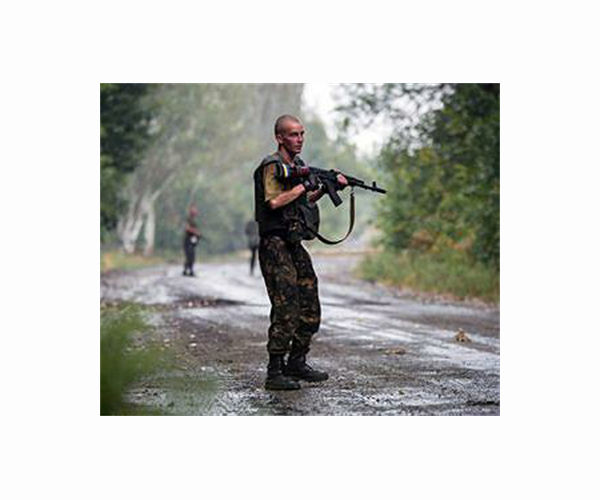
The Pentagon said Friday that the destruction and human cost of a full-scale incursion by Russian forces into Ukraine would be "horrific," but that there was still time for diplomacy to avoid a war.
"If that was unleashed on Ukraine, it would be significant, very significant, and it would result in a significant amount of casualties," Chairman of the Joint Chiefs of Staff Mark Milley said.
"And you can imagine what that might look like in dense urban areas, along roads and so on and so forth. It would be horrific, it will be terrible."
Speaking alongside Milley, Defense Secretary Lloyd Austin said conflict in Ukraine could still be avoided, despite Russian President Vladimir Putin amassing more than 100,000 troops along their shared border.
"Conflict is not inevitable. There is still time and space for diplomacy," said Austin.
"Mr. Putin can do the right thing as well," he added. "There is no reason that this situation has to devolve into conflict. He can choose to de-escalate. He can order his troops away," he said.
The remarks of the US military's two top officials, who had been quiet in recent days over the rise in tensions in Eastern Europe, came as there was no sign of a breakthrough in diplomatic efforts to avoid open conflict.
They said Russia continues to add to its forces pointed at Ukraine, with a range of offensive units and capabilities including armor, air power, naval power, missiles, and cyber and political operations.
While the Pentagon officials said they do not believe Putin has made a decision to go to war, they said his options have expanded, from provocations that could lead to an attack in the restive southeast Donbass region, to an attempt to overrun the entire country, attacking urban centers like the capital Kyiv.
"If war were to break out on a scale and scope that is possible, the civilian population will suffer immensely," Milley said.
Russia itself will suffer, he added.
"If Russia chooses to invade Ukraine it will not be cost-free, in terms of casualties or other significant effects."
Austin and Milley stressed that Washington has no intention of sending US troops to Ukraine to defend it, but will continue to support the Ukraine military with arms and other materials.
However, they stressed, the United States was prepared to send troops to reinforce and protect NATO allies in eastern Europe that faced a potential threat from a Russian attack on Ukraine, which is not part of the Atlantic alliance.
"An attack on one NATO ally is an attack against all," Milley warned.
NATO chief sees 'wide range' of possible actions by Russia
Brussels (AFP) Jan 28, 2022 –
Russia could conduct a "wide range" of aggressive acts against Ukraine, NATO chief Jens Stoltenberg said on Friday, but he emphasised the window was still open to a peaceful and negotiated resolution.
While the military alliance is still not sure what the Kremlin might do, Stoltenberg told an event hosted by the US think-tank the Atlantic Council that Russia had several options available.
"Cyber (warfare) is one, coup efforts to topple the government in Kiev, sabotage — they have intelligence officers working inside Ukraine as we speak. So we need to be prepared for a wide range of different forms or aggressive actions by Russia against Ukraine," Stoltenberg said.
But he added he was "reluctant to be going too far into speculating, because the aim now is to try to reduce tensions…. We call on Russia to sit down and engage in talks to prevent these kind of scenarios and to find a political solution".
The West is on tenterhooks over a mass deployment of over 100,000 Russian troops on Ukraine's borders, raising fears that Moscow might be planning a further invasion of its neighbour.
NATO has held several meetings on the perceived threat, and has another planned for February 16-17 of allied defence ministers.
Stoltenberg admitted "there are some differences between allies" on what support should be extended to Ukraine, which is not a member of NATO and would not receive any deployment of combat troops.
The US, Britain and Canada are providing weapons and military trainers, while others, such as Germany, are holding back.
"There's no certainty about the Russian plans," he said.
"From the NATO side, we are ready to engage in political dialogue. But we're also ready to respond if Russia chooses an armed conflict, confrontation. So we are ready for both options," he said.
"We are working hard for the best peaceful political solution, but we also prepared for the worst."