
Orbital Sciences Corporation
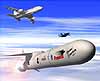
successfully launched NASA's Student Nitric Oxide Explorer (SNOE) satellite, as well as Teledesic LLC's T1 satellite, the world's first commercial Ka-band low-Earth orbit (LEO) satellite, late Wednesday night, February 25 using a Pegasus launcher.
The launch originated from Vandenberg Air Force Base, California when
Orbital's L-1011 “Stargazer'' carrier aircraft took off at approximately 10:05
p.m. Pacific time. The aircraft flew off the California coast at an altitude
of 39,000 feet to a pre-determined location over the Pacific Ocean, where the
Pegasus rocket was released and ignited its first stage at approximately 11:05
p.m. After a flight of approximately 10 minutes, Pegasus delivered the SNOE
and T1 satellites into their planned orbits at an altitude of approximately
565 kilometers, inclined at 97.7 degrees. Initial communications were with
the SNOE satellite were established as it passed over a ground station at
Poker Flat, Alaska about an hour after its deployment.
Initial communications with the T1 satellite are expected to be
established later today at Orbital's satellite ground control station at the
company's Dulles, Virginia headquarters.
The SNOE Satellite
The SNOE spacecraft and its instruments were designed and built by a team
of students and engineers at the University of Colorado's Laboratory for
Atmospheric and Space Physics. The 254 pound satellite carries three
instruments: an ultraviolet spectrometer to measure nitric oxide altitude
profiles, a two-channel photometer to measure auroral emissions beneath the
spacecraft and a five-channel solar soft X-ray photometer. SNOE will
investigate the effects of energy from the sun and the magnetosphere on the
density of nitric oxide in the Earth's upper atmosphere. The extreme
variability of nitric oxide may also be important to ozone chemistry in the
middle atmosphere.
SNOE is the first of three student satellite projects selected to be built
under the Student Explorer Demonstration Initiative (STEDI) program. Funded
by NASA and managed by the Universities Space Research Association, STEDI is a
pilot program designed to assess the effectiveness of smaller, low-cost space
flight missions. The next STEDI mission, Boston University's TERRIERS
satellite, is also scheduled to be launched on Pegasus.
Teledesic's T1 Satellite
Teledesic's T1 satellite, previously called the Broadband Advanced
Technology satellite (BATSAT), is an experimental satellite designed and built
by an Orbital, Teledesic and Boeing team. Known as T1 for Teledesic 1, it is
the world's first commercial “Ka'' frequency band LEO spacecraft. The T1
satellite is part of Teledesic's ongoing developmental effort to build its
global, broadband “Internet-in-the-Sky'' network, which was licensed by the
Federal Communications Commission last year. Teledesic plans to use a
constellation of 288 low-Earth-orbit satellites to create the world's first
network providing affordable, worldwide, “fiber-like'' access to
telecommunications services, such as linking enterprise computing networks,
broadband Internet access, videoconferencing and other digital data needs.
The Kirkland, Wash.-based company is backed by telecommunications pioneer
Craig McCaw and Microsoft Chairman Bill Gates.
Orbital provided the T1 satellite bus, which is based on the company's
MicroStar(TM) spacecraft platform, and Boeing supplied the payload for the
commercial communications satellite. MicroStar has served as the basis for 14
satellites that are currently in orbit, as well as nearly 30 more satellites
now in production. The latest launch of MicroStar spacecraft occurred on
February 10, 1998, when two ORBCOMM satellites were deployed by Orbital's
Taurus(R) rocket.
The Pegasus Launch System
Orbital's Pegasus rocket is the world's leading launch system for the
deployment of small satellites into low-Earth orbit. Its patented air-launch
system has enabled Orbital to conduct operations from five separate launch
sites, including four sites in the U.S. and one in Europe, the first time a
space launch vehicle has provided such operational flexibility. Pegasus is
carried aloft by the company-owned L-1011 “Stargazer'' aircraft to a point
approximately 40,000 feet over open ocean areas, where it is released and then
free-falls in a horizontal position for five seconds before igniting its first
stage rocket motor.
The SNOE/T1 launch represents the 20th Pegasus mission since the rocket's
debut in 1990. In recent years, Orbital has significantly increased the
number of Pegasus launches performed each year. In 1997, Pegasus scored
perfect marks, successfully conducting five missions for government and
commercial customers. The SNOE/T1 launch is the first of eight Pegasus
missions scheduled for 1998.
