
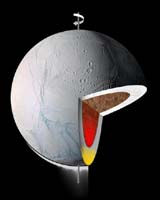
Saturn's moon Enceladus – an active, icy world with an unusually warm south pole – may have performed an unusual trick for a planetary body: It may have rolled over.
Enceladus recently grabbed scientists' attention when the Cassini spacecraft observed icy jets and plumes indicating active geysers spewing from the tiny moon's south polar region.
"The mystery we set out to explain was how the hot spot could end up at the pole if it didn't start there," said lead researcher Francis Nimmo of the University of California, Santa Cruz.
Reporting in Thursday's issue of the journal Nature, Nimmo's team proposes that the reorientation was driven by warm, low-density material rising to the surface from within Enceladus. A similar process may have happened on Miranda, one of the moons of Uranus, they said.
"It's astounding that Cassini found a region of current geological activity on an icy moon that we would expect to be frigidly cold, especially down at this moon's equivalent of Antarctica," said Robert Pappalardo, co-author and planetary scientist at NASA's Jet Propulsion Laboratory. "We think the moon rolled over to put a deeply seated warm, active area there."
Pappalardo worked on the study while at the University of Colorado.
Rotating bodies, including planets and moons, are stable if more of their mass is close to the equator. "Any redistribution of mass within the object can cause instability with respect to the axis of rotation," Nimmo said. "A reorientation will tend to position excess mass at the equator and areas of low density at the poles," which is precisely what happened to Enceladus.
Nimmo and Pappalardo calculated the effects of a low-density blob beneath the moon's surface and showed it could have caused the moon to roll over by up to 30 degrees and create the blob at the pole.
Pappalardo used an analogy to explain the Enceladus rollover: "A spinning bowling ball will tend to roll over to put its holes — the axis with the least mass — vertically along the spin axis. Similarly, Enceladus apparently rolled over to place the portion of the moon with the least mass along its vertical spin axis."
The rising blob – called a diaper – may be within either the icy shell or the underlying rocky core of Enceladus. In either case, as the material heats up it expands and becomes less dense, then rises toward the surface.
This rising of warm, low-density material could also help explain the high heat and striking surface features, including the geysers and tiger-stripe region suggesting fault lines caused by tectonic stress.
Internal heating of Enceladus probably results from its eccentric orbit around Saturn. "Enceladus gets squeezed and stretched by tidal forces as it orbits Saturn, and that mechanical energy is transformed into heat energy in the moon's interior," Nimmo said.
Future Cassini observations of Enceladus may support this model. Meanwhile, scientists await the spacecraft's next flyby of Enceladus in 2008 for more clues.
