
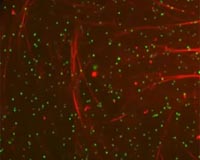
Researchers at Brandeis University in Massachusetts are inching close to the creation of a new kind of matter — a self-propelling liquid.
Scientists at Brandeis' Materials Research Science and Engineering Center are trying to develop a new class of materials and machines powered by unique biomechanical properties. They detailed their latest breakthrough — the discovery of an adaptable cellular nanostructure — in the journal Science.
Microtubules are hollow cylindrical tubes capable of creating dynamic cellular scaffolding. The nanostructures are infinitely malleable, capable of expanding, shrinking, bending and stretching, transforming cellular structure.
After extracting microtubules from a cow's brain, the researchers infused the polymer with kinesin and adenosine triphosphate, two other types of cellular molecules. The kinesin acts as a link between each microtubule as they align end on end. The ATP serves as a fuel source for the material's self-propulsion.
In lab tests, the kinesin's top and bottom moved in opposite directions, breaking the links between the microtubules. The structure briefly broke down, but new kinesin quickly formed new links before being propelled in a bipolar movement.
The cycle created a whirling motion in the liquid, and researchers were able to encourage the swirls to move in the same direction.
The result of the experiments is a microscopic machine able to self-pump liquid. Scientists say the novel motion is essentially a simplified version of the kinetics found inside a cell.
The research could eventually be used to create an array of new technologies, like oil pipelines that pump themselves.
Groundbreaking process for creating ultra-selective separation membranes
A team of researchers, led by the University of Minnesota, has developed a groundbreaking one-step, crystal growth process for making ultra-thin layers of material with molecular-sized pores. Researchers demonstrated the use of the material, called zeolite nanosheets, by making ultra-selective membranes for chemical separations.
These new membranes can separate individual molecules based o … read more
