
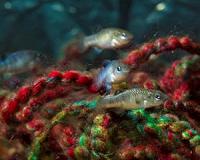
The saltwater lakes of the Bahama's San Salvador Island are home to a rich diversity of fish species, including several species of Bahama pupfish. What makes such diversity possible?
In a new study, scientists have offered a genetic explanation for how at least three pupfish species coexist in the same lake. The key, researchers suggest, is specialization.
Over the last 10,000 years, the three pupfish species have carved out their own food niches by evolving specialized jaws. Like Darwin's finches in the Galapagos, each with a beak adapted to specific seeds, the Bahama pupfish have adapted their jaws to monopolize specific foods — algae, snails and other small fish.
To find out which genes are responsible for jaw specialization, researchers sequenced 37 genomes from nine populations representing all three species. Among the 12 million single DNA mutations identified by the survey — also known as single nucleotide polymorphisms, or SNPs — researchers found several gene candidates strongly associated with jaw size.
"Overall, we uncovered very few regions with single SNPs fixed between species that were also strongly associated with divergent jaw sizes," researcher Christopher Martin explained in a news release. "Many of these regions contained only a single gene with known effects on skeletal development in model organisms."
While the new research, published in the journal Molecular Biology and Evolution, helps explain the genetic origins of pupfish jaw adaptation, it fails to explain why jaw diversification happened on San Salvador and not elsewhere.
"Answering this question will require continued exploration of the ecological and genetic factors shaping this exceptional case of rapid ecological specialization," Martin concluded. "So far, the usual suspects — lake area, ecological and genetic diversity — do not seem to provide the trigger of adaptive radiation as is commonly assumed. Instead, the answer seems to be far more complex and interesting than we ever imagined."
