
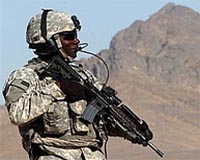
Four British troops were killed in two separate explosions Friday in troubled southern Afghanistan, the Ministry of Defence said.
"Four Royal Marines were killed in two separate incidents in the Sangin area of Helmand province this morning," the MoD said in a statement.
In the explosion which occurred south of the town of Sangin, three marines — two from 45 Commando and one from Commando Logistics Regiment — were killed.
"They were taking part in a routine operation against enemy forces in the area," the MoD said.
One marine died instantly, a second died of his wounds before he could be evacuated and the third died of his wounds in the hospital at Camp Bastion, Britain's main base in Afghanistan.
The other explosion took place in the Sangin area. One soldier from 45 Commando, who was taking part in a routine patrol, was killed as a result. He died of his wounds while being taken to Camp Bastion.
Expressing her sympathies on an "incredibly sad day," Commander Paula Rowe, a spokeswoman for Task Force Helmand, said: "The tragic deaths of these Royal Marines have come as a huge blow to us all."
Next of kin had been informed.
The deaths take to 132 the total number of British service personnel killed in Afghanistan since 2001, when US-led forces ousted the Taliban in the wake of the September 11 attacks in New York and Washington.
They are the first since two Royal Marines from 42 Commando were killed on November 27. They were shot at by insurgents while on foot patrol north-west of Lashkar Gar in Helmand Province.
Britain has around 8,000 troops in Afghanistan, largely based in Helmand, where they are battling Taliban insurgents.
The MoD's announcement came two and a half hours after it confirmed the 178th British military fatality in the Iraq campaign, an incident in which a soldier shot himself.
earlier related report
NATO patrol kills three Afghan civilians: alliance
NATO troops killed three civilians and wounded six others in southwest Afghanistan Friday after the bus they were travelling in failed to heed warning shots, the alliance said.
The patrol opened fire "in self-defence" when the minibus continued to speed towards them after the warnings, a press statement said.
US and NATO-led forces carry warning signs on their convoys telling Afghan drivers to keep their distance, fearing suicide car bomb attacks.
"Three Afghans were killed in the Sayed Abad District of Wardak province this morning during an 'escalation of force' incident," the statement said.
The patrol fired initial warning shots, then fired into the bus's engine when the driver failed to stop, it said.
"Despite this, the bus continued towards the patrol. As a result the patrol was forced to fire upon the bus in self-defence," it said.
The patrol treated the wounded on site and coalition aircraft later evacuated the wounded to international military hospitals, it said.
The governor of Wardak province confirmed the incident and said six civilians were wounded.
Incidents in which Afghan civilians are killed when they come too close to NATO-led International Security Assitance Force (ISAF) troops, convoys or bases after failing to heed warnings are relatively common.
Many civilians are also killed accidentally in air strikes by international forces targeting Taliban and other militants.
On Wednesday, six Afghan policemen and a civilian were killed when US-led coalition forces targeting a Taliban commander bombed a police station in southern Zabul province.
President Hamid Karzai's government has repeatedly called on the forces to review their rules of operations to avoid such incidents, warning they serve only to turn Afghans against international efforts here.
In August this year, more than 90 civilians, most of them children, were killed in an air raid by the US-led forces against Taliban-linked militants in the western province of Herat.
About 70,000 international military forces including those of NATO are stationed in Afghanistan to fight a Taliban-led insurgency launched in 2001.
The Taliban were in government between 1996 and 2001 before being ousted in a US-led invasion following the September 11, 2001 attacks on US cities which they blamed on Al-Qaeda operatives based in Afghanistan.
Share This Article With Planet Earth
