
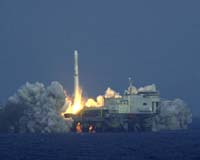
Sea Launch announced Monday it has signed a contract with Boeing Satellite Systems International to use a Sea Launch Zenit-3SL vehicle to lift the Thuraya-3 satellite into geosynchronous transfer orbit from Sea Launch's equatorial launch site in the Pacific Ocean in January 2007.
Boeing is designing and building the 5,250-kilogram (11,578-pound) GEO-Mobile spacecraft at its Satellite Development Center in El Segundo, Calif., for the Thuraya Satellite Telecommunications Company.
The satellite, intended to expand the Thuraya system's capacity, integrates a high-power spacecraft with a ground segment and user handsets to provide a range of cellular-like voice and data services regionally. The Thuraya ground segment includes terrestrial gateways plus a co-located network-operations center and satellite-control facility in the United Arab Emirates.
"Sea Launch successfully launched Thuraya-1 (in October 2000) and Thuraya-2 (in June 2003)," said Rob Peckham, president and general manager of Sea Launch.
Thuraya, based in Abu Dhabi, in the United Arab Emirates, is a regional mobile satellite system that provides satellite-based telephone services to an area covering more than 100 countries in Europe, Africa, India, the Middle East and Asia, populated by an estimated 2.3-billion people.
Thuraya's mobile phones combine satellite, GSM and GPS and provide services that include voice, data, fax and short messaging.
Boeing's Satellite Development Center in El Segundo, Calif., manufactures government and commercial communications satellites. Encompassing approximately 1-million square feet, its facility is the largest dedicated satellite factory in the world. In addition to the Thuraya-3 spacecraft, the SDC also built the Thuraya-1 and Thuraya-2 spacecraft.
Sea Launch Company is an international partnership that offers heavy-lift commercial launch services to geostationary orbit from its seagoing launch site on the Equator.
