
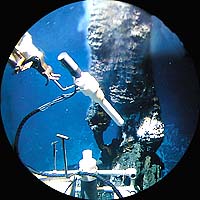
Researchers from the University of Delaware and Analytical Instrument Systems, Inc., have developed an electrochemical analyzer, a kind of underwater "snooper," that can detect the chemicals spewing out of super-hot vents over a mile deep on the ocean floor.
The analyzer, which is mounted to the submarine Alvin, can be parked near a vent to provide readings of the sulfur-rich compounds rocketing out of the Earth's crust.
Ironically, these toxic chemicals may serve as fingerprints, leading scientists to the locations of deep-sea organisms that may be beneficial to humankind.
"This is the first time a system like this has been built to operate at such great depths and pressures," says UD chemist George Luther, who will report on the tool March 29 during the American Chemical Society meeting.
"So far, the analyzer has been tested at a depth of 2,500 meters. At that depth, the pressure is more than 200 times what it is here on the surface.
"The analyzer also has proven itself under a wide range of deep ocean temperatures, from just above freezing to 100 degrees Celsius at the vents," said Luther.
The system consists of two units. The first is a foot-long wand that houses several gold/amalgam electrodes coated in a super-tough plastic.
This portion of the system was designed by Luther and his team at the UD College of Marine Studies. The wand is attached to one of Alvin's highly maneuverable arms for placement near the vents.
The wand also is connected to a 3-foot-long, 8-inch-diameter tube that houses the system's electronics. Designed by Donald Nuzzio, president of Analytical Instrument Systems Inc. in Flemington, New Jersey, this component is mounted to the bottom of the sub.
A 2-inch-thick anodized aluminum housing protects the electronics from imploding under the crushing weight of the deep sea.
The analyzer can detect a number of chemical compounds simultaneously, such as iron monosulfide (the dissolved form of FeS), hydrogen sulfide, thiosulfate, polysulfide, and others.
