
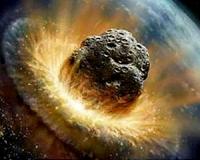
Scientists have found direct evidence that a comet struck the Earth more than 50 million years ago, coinciding with a warm period often compared with today's global warming, a report said Thursday.
The findings in the journal Science do not prove that the impact unleashed an unusual amount of carbon dioxide.
Rather, they provide more support to the highly debated theory that a sudden impact, rather than volcanic eruptions or some other cause on Earth, may have led to the warming period known as the Paleocene-Eocene Thermal Maximum (PETM).
"This could very well be the ground zero" of the PETM, said study co-author Dennis Kent, a researcher at Columbia University's Lamont-Doherty Earth Observatory and Rutgers University.
"It got warm in a hurry. This suggests where it came from."
Digging near what is now New Jersey, Kent and colleagues found small, round droplets of glass called microtektites.
These sand-grain-sized spheres are thought to form when an extraterrestrial object hits the Earth, spraying out vaporized material that solidifies while flying through the air, said the study.
"It's got to be more than coincidental that there's an impact right at the same time," said lead author, Morgan Schaller, a geochemist at Rensselaer Polytechnic Institute.
"If the impact was related, it suggests the carbon release was fast."
Scientists say the outpouring of carbon took place over a period of 5,000-20,000 years.
Other theories suggest that a period widespread volcanism led to the sudden release of greenhouse gases, such as frozen methane from the seafloor.
Some think changes in the earth's orbit or shifts in ocean circulation also played a part in the rise of 9-16 Fahrenheit (5-9 Celsius) for a period of about 200,000 years.
The changes meant that ice virtually disappeared from the Earth and sea levels were far higher than today.
Some creatures went extinct, others migrated toward the poles.
Experts say carbon emissions "are now far outpacing anything that took place during the PETM," said a statement from Columbia University.
"The consequences might be more drastic, because many life forms will not have time to evolve or move."
A separate study earlier this year showed that fossil fuel burning and pollution is sending carbon into the atmosphere 10 times faster than the natural forces that unleashed the warming 55 million years ago.
– No crater –
Still, researchers have not found the crater that would have been caused by such a massive strike.
"It could have been next door, or it could have been on the other side of the planet," said Schaller.
Since the small spheres are thinly spread, the impact could have been large but far away, or close but relatively small, he said.
According to Charles Langmuir, a paleoclimate researcher at Harvard University who was not involved in the study, the evidence of an impact at or near the start of the PETM period is "very strong."
Langmuir also said, however, that the study does not address what caused the carbon release, or how long it took.
Nor is it certain that the spherules came from a massive comet impact 55 million years ago.
The researchers did not directly establish the spherules' age using radiometric dating, leaving open the possibility that they came from another time and were worked into the PETM sediments, according to Christian Koeberl, an impact specialist at the University of Vienna.
An extraterrestrial object that landed off Mexico's Yucatan Peninsula 11 million years earlier is thought to have led to the extinction of the dinosaurs.
About 20 million years after the PETM, yet another impact hit the area, carving out what is now the Chesapeake Bay off the coast of Maryland.
Gerald Dickens, a marine geologist at Rice University, said the latest research does not "really explain anything."
There are "multiple arguments for why the carbon input took thousands of years," he said.
"Finding a few spherules does not change this."
