
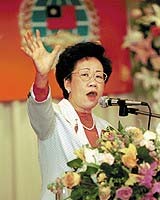
Taiwan's Vice President Annette Lu on Wednesday defended President Chen Shui-bian's renewed tough line on China, a move which the United States has warned could send the wrong signals to Beijing.
"My feeling is that the president may think we should have a say on Taiwan's own future," Lu explained.
Chen said Sunday he would "seriously consider" abolishing guidelines on reunification with China and the council that created them.
Eliminating them could fuel Beijing's suspicions that he is pushing for independence for the island which China regards as a part of its territory.
Chen's remarks, made during a Lunar New Year event, drew criticism from Taiwanese opposition leader Ma Ying-jeou who favors improved ties with rival China and urged Chen to keep his previous promises of not scrapping the National Unification Council and guidelines.
Lu however blamed Beijing for the persistent political standoff.
"President Chen said if China did not use force to menace Taiwan, then he would not break the promises he made," Lu said.
Chen has also suggested reapplying to join the United Nations in the name of "Taiwan" instead of the island's official title, "Republic of China." He also called for putting a new constitution to a vote later this year.
His remarks surprised US officials, who this week reiterated Washington's opposition to Taiwan's independence and to changes in the status quo across the Taiwan Strait.
Chen pledged during his inauguration in 2000 to uphold the council and the guidelines and said he would not seek formal independence for the island.
He reiterated that promise in 2004 after he was narrowly reelected for a second and final term.
China and Taiwan split in 1949 after a civil war but Beijing still claims the island and threatens to invade if it formally declares independence, but relations have worsened since Chen took office.
