
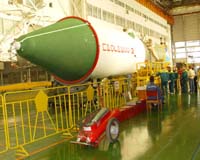
Technicians are preparing the next Russian Progress M-57 space freighter for its launch this weekend on a mission to deliver supplies to the crew of the International Space Station. Technicians from Energia RSP transported the spacecraft, dubbed Progress 22, from the processing facility at the Baikonur Cosmodrome to the integration facility.
After mating with the Soyuz-U launch vehicle, the rocket will be moved to the launch pad for Saturday's scheduled liftoff.
The Progress will deliver fuel, consumables, scientific and research equipment, foodstuffs and water to the crew of the 13th ISS mission: Russia's Pavel Vinogradov, the commander, and NASA astronaut Jeff Williams, the flight engineer.
When Progress arrives at the station, it will have the distinction, at least for a while after its unloading, of serving as a closet rather than a garbage can for the orbiting laboratory.
The 22nd Progress to visit the station will carry just over 2.5 tons of equipment and supplies. Included will be more than 1,900 pounds (855 kilograms) of propellant, just over 100 pounds (45 kilos) of air and oxygen, almost 250 pounds (112.5 kilos) of water and almost 2,860 pounds (1,285 kilos) of dry cargo.
The station crew undocked the Progress 20 spacecraft on Monday. It was de-orbited and destroyed with its load of trash and station discards upon re-entry.
Progress 21, which arrived at the station April 23, remains at the aft docking port of the Zvezda service module. It is scheduled to be undocked and de-orbited on Sept. 13.
Progress 22 is set to launch at 7:08 p.m. local time on Saturday. Its docking to the Pirs docking compartment is scheduled for June 26 at 12:27 a.m.
Plans call for Progress 22 to be used after it is unloaded as a closet. It will provide additional stowage space, rather than act as a trash receptacle. Many items eventually to be stowed aboard will be delivered by shuttle Discovery on STS-121, scheduled to launch on July 1.
Progress 22 unloading will begin only after Discovery's departure.
Progress is similar in appearance and some design elements to the Soyuz spacecraft, which brings crewmembers to the station, serves as a lifeboat while they are there and returns them to Earth. The aft module, the instrumentation and propulsion module, is nearly identical.
The second of the three Progress sections is a refueling module, and the third – uppermost as the Progress sits on the launch pad – is a cargo module. On the Soyuz, the descent module, where the crew is seated on launch and which returns them to Earth, is the middle module and the third is called the orbital module.
