
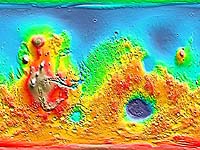
NASA's Mars Global Surveyor will complete its primary mapping mission of Mars on January 31, 2001 after a mapping mission that lasted one full Mars year (687 days). During this time MGS was able to globally map the planet while monitoring seasonal changes.
With the spacecraft and instruments still healthy and collecting excellent data NASA has approved an extended mission that will commence directly after the mapping mission. As a result data from the MOLA laser altimeter instrument will keep flowing.
But in light of the end-of-mapping mission milestone, the MOLA Science Team has collectively looked back at the scientific advances enabled by MOLA observations and made a list of the "top 10".
Believe it or not, there was almost no argument about the items on the list, which are presented in no particular order.
The most accurate global topographic map of any planet in the solar system, including a two-order-of-magnitude improvement in the geodetic grid (latitude/longitude system) of Mars.
Recognition of the flat northern hemisphere of Mars.
The pole-to-pole slope and Tharsis control the shape of the planet.
Detection of buried basins beneath the northern hemisphere plains that has clarified the large impact basin population.
The first reliable inversion for the crustal structure of Mars (using both MOLA and MGS gravity data from the Radio Science Experiment).
Establishment of the pathways for the flow of past water and the locations, sizes, and volumes of watersheds.
All craters greater than a few kilometers in size display ramparts, indicating that water was pervasive in the Martian subsurface.
Present-day surface water inventory from polar cap/layered terrain volumes.
Detection of the heights of clouds and identification of dynamical features in the atmosphere, such as gravity waves.
Stay tuned. Paper to be submitted shortly.
Source: MOLA Science Team
