
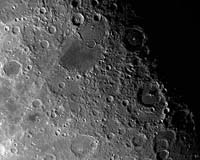
U.S. scientists say a study of Apollo-era and recent spectral data suggests the moon may have produced interior gas eruptions more recently than thought. Brown University geological science Professors Peter Schulz and Carle Pieters note conventional wisdom suggests the Earth's moon has seen no widespread volcanic activity for at least 3 billion years. But now they say the data point to much more recent events.
The study, in collaboration with Matthew Staid of the Planetary Science Institute, uses three lines of evidence to support the assertion that volcanic gas has been released from the moon's surface within the last 1 million to 10 million years. Those three lines of evidence concern the unusual sharpness of features, the scarcity of asteroid impact craters, and a comparison of the spectral signatures of lunar surface deposits.
Over the years, says Schultz, amateur astronomers have seen puffs or flashes of light coming from the moon's surface. Although most professional observers have upheld the conclusion that the moon was inactive, such sightings have kept open a window of doubt.
NASA's Planetary Geology and Geophysics Program supported the research, which is detailed in the journal Nature.
