
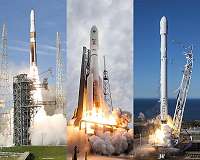
Space exploitation and exploration are expensive. For example, the transportation cost for each lemon sent to the International Space Station (ISS) may cost over $2,000. Such lemons and other food supplies are sent to the station periodically by cargo modules from US suppliers and Russia.
Since the retirement of the Space Shuttle in 2011, NASA has been using other sources for resupplying the station. Initially, Russia provided this service, but more recently, the private sector has joined in this activity. The objective was to reduce the costs of resupplying the ISS.
Beginning in 2008, NASA signed contracts with SpaceX and Orbital ATK in the amount of $1.6 billion and $1.9 billion, respectively, for a total of 20 resupply launches to ISS. This breaks down to an estimated cargo cost of $27,000 per pound for SpaceX and $43,000 per pound for Orbital ATK. Now compare this to using the Shuttle.
The cost per pound would be an estimated $10,000. The main reason seems to be the scale factor. The Shuttle could carry 50,000 pounds and seven astronauts, while the new commercial robotic modules can carry only 5,000 pounds.
Even if each Shuttle flight cost as much as $1.5 billion, the cost per pound would be comparable to commercial options. Of course, this comparison is overly simplified, because a thorough cost analysis would be very complicated.
Lets' take a close look at two specific items. The cost of a single 16-ounce bottle of water ranges from $9,100 to $43,180. Yes, water is necessary for life, but it is crazy expensive in space.
At these prices NASA decided to recycle water from sweat and other sources. An Italian astronaut, Samantha Cristoforetti, got a taste of home when an espresso machine arrived on the ISS. The cost of delivering the 44-pound item was $1.9 million.
Is it all worth it? Well, everyone has an opinion. Experiments conducted on the ISS have a huge potential for discovery and education about the human body and the future of space flight. Over the past 60 years NASA's space programs have yielded huge advances in technology that we use every day here on Earth. In fact, the return on investment has been outstanding.
