
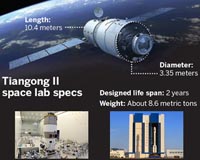
Several days after its launch, China's Tiangong 2 space laboratory seems to be working well. The uncrewed module has made engine burns and orbital changes, demonstrating its capabilities.
China is making reassuring statements about its performance. Tiangong has clearly passed over the challenges of early failure syndrome, which sometimes cripples spacecraft shortly after launch.
At this stage, there are probably more tests to be performed on the module, but it seems to be passing every task. This bodes well for the next chapter in the Tiangong 2 saga. China will launch the Shenzhou 11 spacecraft at some point in October, carrying two astronauts to live on board the laboratory.
At this time, we have no official word on a launch date. Nor do we know the identities of the astronauts. We know that the crew will live on Tiangong 2 for around 30 days, making this the longest Chinese crewed space mission to date. It's also smaller than the three-person crews that inhabited Tiangong 1. Reducing crew size is critical to conserving logistics, which in turn allows this longer mission to take place.
There's one footnote to the launch to review. China calls the launch vehicle for Tiangong 2 the "Long March 2F/T2". That's a change from the Long March 2F/G designation used for Tiangong 1, which was basically the same rocket.
We were told that there were some modifications to the launch vehicle, but how far do the changes really go? Were they enough to prompt the revised nomenclature, or does this merely reflect some bureaucratic whimsy? Or is the "G" designation now being reserved for some future version of the Long March 2 series?
On with the show. The best is yet to come.
