
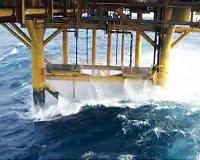
President Donald Trump's plans to allow offshore oil drilling along virtually the entire US coastline threaten millions of jobs and billions in economic output, according to a report published Wednesday.
The report could buttress the arguments of local governments which oppose the proposed new drilling, fearful of losses to tourism, fishing and the potential for environmental disasters.
To encourage domestic energy production, the Trump administration said in January it would undo restrictions put in place by the prior administration and allow drilling on more than a billion acres of coastal waters off California, the Eastern Seaboard, the eastern Gulf of Mexico and the Arctic.
The proposal was welcomed by industry but is fiercely opposed by governors of coastal states, including the Republican governors of Florida and South Carolina. The plan also faces legal challenges.
According to the marine conservation group Oceana, the offshore drilling proposal would endanger more than 2.6 million jobs and nearly $180 billion in economic output for the chance to develop two years' worth of oil and a year's worth of natural gas.
"Coastal communities and states are outraged by this radical plan that threatens to destroy our clean coast economies," Oceana campaign director Diane Hoskins said in a statement.
The report said it derived its figures by analyzing Commerce and Interior Department data on ocean-related employment and GDP as well as estimates of undiscovered oil and gas reserves that are economically recoverable.
Interior Secretary Ryan Zinke announced in January that Florida waters would be excluded but analysts say this will strengthen arguments by other states which are also seeking exemptions.
Another senior Interior official testifying before Congress less than two weeks later said no final decision on Florida had in fact been made.
BP's 2010 Deepwater Horizon oil rig disaster in the Gulf of Mexico, the largest-ever oil spill in ocean waters, drove former president Barack Obama to ban oil drilling across large areas of the Arctic and Atlantic coasts — a legacy Trump is seeking to undo.
Offshore drilling plan may put 2.6M jobs in jeopardy, conservation group says
Washington (UPI) Mar 7, 2018 –
President Donald Trump's plan to open most of the coastal U.S. to offshore drilling jeopardizes at least 2.6 million jobs and almost $180 billion in gross domestic product, according to a new economic analysis from ocean conservation group Oceana.
Trump's plan, announced in January and potentially kicking in next year, would only supply two years' worth of oil and one year's worth of gas while sacrificing the vitality of the fishing, tourism and recreation industries along the Atlantic, Pacific and Florida's Gulf coasts, Oceana said.
"From ocean views scattered with drilling platforms, to the industrialization of our coastal communities, to the unacceptable risk of more BP Deepwater Horizon-like disasters — expanding offshore drilling to new areas threatens thriving coastal economies and booming industries like tourism, recreation and fishing that rely on oil-free beaches and healthy oceans," Diana Hoskins, Oceana campaign director, said in a statement.
Trump's proposal included 19 lease sales off the coast of Alaska, seven in the Pacific, 12 in the Gulf of Mexico and nine in the Atlantic.
Oceana called it "the largest number of potential offshore lease sales ever proposed." Interior Secretary Ryan Zinke said at the time of the announcement that the plan would "strike the right balance to protect our coasts and people while still powering America and achieving American Energy Dominance."
The Trump administration's plans would open more than 90 percent of the Outer Continental Shelf acreage for energy development, a sharp contrast to an Obama-era policy preventing that activity in 94 percent of the OCS.
There has been some confusion over the Trump plan — specifically about the inclusion of Florida. After the proposal's announcement, Zinke told Florida Gov. Rick Scott that Florida would no longer be included. Later, however, acting Director of the Bureau of Ocean Energy Management Walter Cruickshank said federal officials could still open Florida to offshore drilling.
Elected officials in other coastal states have since sought similar immunity from drilling.
In light of the offshore drilling proposal, a group of Senate Democrats sent a letter to Zinke last month, asking the Interior Department to continue a study of rig inspections conducted by the Bureau of Safety and Environmental Enforcement.
Zinke has since unveiled a number of new measures he hopes will strengthen BSEE's inspections. The Interior Department said in a release this week that, among those measures, is an emphasis on the inspection of offshore "critical equipment or operations" and freeing up inspectors to spend more time conducting inspections on-site.
