
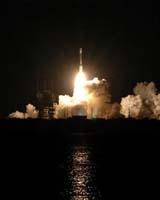
NASA's STEREO (Solar TErrestrial RElations Observatory) spacecraft – en route as the first mission to capture the sun in 3-D – successfully launched tonight aboard a single Delta II vehicle from Cape Canaveral Air Force Station, Fla., at 8:52 pm EDT.
The two nearly identical spacecraft, designed, built and operated for NASA by the Johns Hopkins University Applied Physics Laboratory (APL), in Laurel, Md., separated from the launch vehicle 25 minutes after lift-off. After receiving the first signal from the spacecraft 63 minutes after launch, mission control personnel at APL confirmed each observatory's solar arrays successfully deployed and were providing power to the spacecraft. The initial radio signals were forwarded to the APL-based STEREO Mission Operations Center from NASA's Deep Space Network antennas in Canberra, Australia.
During its two-year mission, the twin observatories will explore the origin, evolution and interplanetary consequences of coronal mass ejections. These powerful solar eruptions are a major source of the magnetic disruptions on Earth and a key component of space weather, which can greatly affect satellite operations, communications, power systems, and the lives of astronauts in space.
Placing STEREO into Orbit
For the next few weeks, the spacecraft will fly in an elliptical orbit that extends from Earth just beyond the moon. During this time, mission operations personnel at APL will place the spacecraft in flight mode, turn on and check out all instruments and subsystems, and ensure all systems are operating nominally in preparation to begin their data collection efforts.
In approximately two months, mission operations personnel at APL will synchronize spacecraft orbits and direct one observatory to its position ahead of Earth. In approximately three months, the second observatory will be redirected to its position trailing Earth. Just as the slight offset between your eyes provides you with depth perception, this placement will allow the STEREO observatories to obtain 3-D images and particle measurements of the sun.
Lunar swingbys will be used to place the observatories into their respective orbits, using the moon's gravity to redirect them to their appropriate orbits – something the launch vehicle alone can't do. This is the first time lunar swingbys have been used to manipulate orbits of more than one spacecraft.
Each STEREO observatory is carrying two instruments and two instrument suites, providing more than a dozen instruments per observatory. APL designed and built the spacecraft platform housing the instruments. When combined with data from observatories on the ground or in space, STEREO's data will allow scientists to track the buildup and liftoff of magnetic energy from the sun and the trajectory of Earth-bound coronal mass ejections in 3-D.
earlier related report
Pratt and Whitney Rocketdyne's RS-27A Sends Solar Observatory on Mission to Study the Sun
A Pratt and Whitney Rocketdyne (PWR) RS-27A rocket engine powered a new observatory into space today that will study eruptions from the surface of the sun. NASA's Solar Terrestrial Relations Observatory — or STEREO — will provide a new perspective on solar activity by capturing images from twin satellites at the same time. Pratt and Whitney Rocketdyne is a business unit of United Technologies (NYSE: UTX) .
Generating 200,000 pounds of thrust, the PWR RS-27A engine boosted a Boeing Delta II and its STEREO payload from the Cape Canaveral Air Force Station in Florida. The nearly four-minute RS-27A burn time positioned the Delta II first stage for release of the second stage and payload to complete the mission.
"Through the years our customers have always known they can count on this remarkable engine to do the job," said Elizabeth Jones, RS-27A program manager. "That's why the RS-27A has long been the engine of choice in this active segment of the launch business. And that, in turn, is a strong testament to the dedication and skills of the team that builds it."
In over three decades, the RS-27 has been one of the most reliable booster engines in the world, continuing PWR's legacy for propulsion excellence — a legacy that goes back more than a half-century. The RS-27 family has scored a 100-percent success record since the 1970s, with 210 launches to date.
Pratt and Whitney Rocketdyne, Inc., a part of Pratt and Whitney, offers a complete line of propulsion products from launch vehicles to missile defense to advanced hypersonic propulsion. These have been used in a wide variety of government and commercial applications, including the main engines for the space shuttle, Atlas and Delta launch vehicles, and high altitude defense systems.
Pratt and Whitney is a world leader in the design, manufacture and service of aircraft engines, space propulsion systems and industrial gas turbines. United Technologies provides high-technology products and services to the aerospace and building industries.
earlier related report
ATK Propulsion and Composite Technologies Support Successful Launch of Delta II Rocket
ATK solid propulsion and composite technologies supported last night's successful launch of a Boeing Delta II rocket from Cape Canaveral Air Force Station, Fla. The launch began NASA's Solar Terrestrial Relations Observatory (STEREO) mission to study the sun. The two-year mission, involving a pair of near-identical satellites, will provide scientists with the first 3D images of the sun and allow them to study powerful solar eruptions called coronal mass ejections.
Nine GEM-40 solid propulsion strap-on boosters manufactured by ATK provided augmented thrust for the launch. Six of the boosters ignited at lift-off with the first-stage main engine and provided over 850,000-lbf maximum thrust for the launch vehicle. Just over a minute later, the remaining three boosters ignited to provide an additional 450,000-lbf maximum thrust. The spent motors were jettisoned from the rocket as it continued its ascent.
Following burnout and separation of the GEM-40 boosters and the rocket's liquid second stage, an ATK-produced STAR(TM) 48B third-stage rocket motor boosted the two observatories from a low-Earth orbit toward the moon where they will gain a gravity assist to enter unique orbits that will optimize their views of solar activity. The two observatory satellites were encapsulated by a 10-ft-diameter composite fairing manufactured by ATK in Iuka, Miss. This launch marked the fifth ATK 10-ft composite fairing flown on a Delta II mission.
