
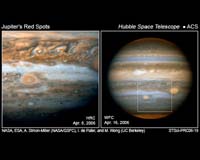
The two biggest storms in the solar system are about to bump into each other in plain view of backyard telescopes. Storm 1 is the well-known Great Red Spot, twice as wide as Earth itself, with winds blowing at 350 miles per hour – faster than a Category 5 tornado.
The behemoth has been spinning around Jupiter for hundreds of years.
Storm 2 is called Oval BA, but better-known as Red Jr., a youngster of a storm only six years old. Compared to the Great Red Spot, Red Jr. is only Earth-sized, but it blows just as hard as its older cousin.
Astronomers have been watching as the two are converging. Closest approach will come on the Fourth of July, according to Amy Simon-Miller of NASA's Goddard Space Flight Center who has been monitoring the storms using the Hubble Space Telescope.
"There won't be a head-on collision," Simon-Miller said. "The Great Red Spot is not going to 'eat' Oval BA, or anything like that." Still, the storms' outer bands will pass quite close to one another – and no one knows exactly what will happen.
"The distance between the storms is shrinking visibly every night," she said.
Similar encounters have happened before, said Glenn Orton of NASA's Jet Propulsion Laboratory. "Oval BA and the Great Red Spot pass each other approximately every two years." Previous encounters in 2002 and 2004 were anti-climatic. Aside from some roughing around the edges, both storms survived apparently unaltered.
This time might be different. Simon-Miller and Orton both think Red Jr. could lose its red color by passing too close to the Great Red Spot. It turns out that Red Jr. was not always red. For five years – from 2000 to 2005 – the storm appeared pure white like many other small white ovals circling the giant planet's surface.
Then, in 2006, astronomers noticed a change: A red vortex formed inside the storm, the same color as the Great Red Spot. This was a sign, researchers thought, that Oval BA was intensifying.
The Great Red Spot's color itself remains a mystery. A popular theory holds that the storm dredges up material from deep inside Jupiter's atmosphere, lifting it above the highest clouds where solar ultraviolet rays turn chromophores, or color-changing compounds, red. Oval BA turned red when it became strong enough to perform the same trick.
Bumping up against the Great Red Spot, however, could weaken Oval BA, turning it white again. "We believe the Great Red Spot will push Oval BA toward a southern jet stream, which is blowing against the oval's counterclockwise rotation," Simon-Miller said.
This would slow Oval BA's spin, possibly reversing the process that reddened it in the first place.
