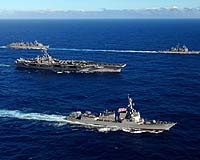
The US navy said on Tuesday it is staging major war games in the Gulf with two aircraft carriers for the first time since the 2003 invasion of Iraq, at a time of heightened tension with Iran.
The manoeuvres involve the USS John C. Stennis, the USS Dwight D. Eisenhower and their battle groups.
They are being held as tensions run high between the West and the Islamic republic over Tehran's nuclear drive and the capture last week of 15 British marines and sailors in a waterway between Iran and Iraq in the northern Gulf.
"Two air wings from the aircraft carriers will conduct air warfare exercises while the surface components will conduct exercises in three general disciplines: anti-submarine, anti-surface and mine warfare," the Fifth Fleet said in a statement.
"This exercise demonstrates the importance of both strike groups' ability to plan and conduct dual task force operations as part of the US long-standing commitment to maintaining maritime security and stability in this region."
The Fifth Fleet is based in Bahrain, an island state which lies across the Gulf from Iran.
The United States announced in January that it plans to keep the two carrier battle groups in the Gulf for months to step up the US military presence in the oil-rich region.
US President George W. Bush said the moves were aimed at bolstering security and protecting US interests in the Middle East, while Defence Secretary Robert Gates said the deployment was a signal to Iran.
"It will be the first time since '03 that we've had two carriers in the region," said a senior US military official, referring to the year of the US-led invasion of Iraq.
The USS John Stennis group with its 6,500-strong force, which has been in the Gulf of Oman since February 19, entered Gulf waters on Tuesday escorted by the guided-missile carrier USS Antietam, the Fifth Fleet said.
earlier related report
Gulf exercise to reassure allies, not confront Iran: US
Washington (AFP) March 27 – An unusual exercise involving two US aircraft carrier strike groups in the Gulf is aimed at reassuring friends and allies, not raising tensions with Iran, a Pentagon spokesman said Tuesday.
He also denied that the two day exercise involving the aircraft carriers USS Dwight D. Eisenhower and USS John S. Stennis is in response to the seizure by Iran of 15 British sailors and marines.
"We are not interested in confrontation in the Gulf," said the spokesman, Bryan Whitman.
"The fact of the matter is … we have an interest in the stability and security in the Gulf and the United States continues to reassure our allies in the region that we are good partners," he said.
Exercises involving two carrier strike groups are unusual because two such naval formations are rarely in the same area at the same time.
"This is an excellent opportunity," Whitman said. "These two carriers have never operated together before. This is the first chance they've had to operate together."
"The exercise should reassure our friends and our allies of our commitment to security and stability in the region," he said.
The US Fifth Fleet, based in Bahrain, said two air wings from the aircraft carriers will conduct exercises while warships from the strike groups practice anti-submarine, anti-surface and mine warfare.
Whitman said the standoff over Iran's seizure of the British marines and sailors on Friday in the northern Gulf was a separate matter that is being handled diplomatically.
But British Prime Minister Tony Blair warned in a television interview in London that if diplomacy does not succeed in gaining their release "then this will move into a different phase."
Pressed on what that might involve, Blair said: "Well, we will just have to see."
President George W. Bush ordered a second US carrier to the Gulf in January amid a mounting diplomatic confrontation with Iran over its uranium enrichment program and US suspicions that it is bent on developing nuclear weapons.
The second carrier raised the US naval presence in the Gulf to its highest level since the 2003 invasion of Iraq.
But US Defense Secretary Robert Gates and other top administration officials have repeatedly denied that the United States has plans to attack Iran.