
US naval forces have joined the hunt for Islamist militants with suspected Al-Qaeda ties trying to flee Somalia after being defeated by Ethiopian-backed government troops, a top US official said Wednesday, as Kenya closed its border with its lawless neighbour.
The US forces, based in Djibouti, were patrolling the seas off Somalia in a bid to capture some leaders of the Islamic Courts movement, including suspected Al-Qaeda agents wanted for the 1998 bombings of US embassies in East Africa, State Department spokesman Sean McCormack said.
The United States was working closely with Somalia's Horn of Africa neighbours "to ensure that these individuals aren't able to transit those borders," he said in Washington, without providing details of the US deployment.
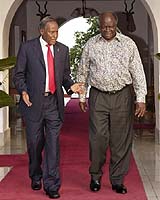
Kenya's Foreign Minister Raphael Tuju meanwhile said his country had closed its border with Somalia to prevent an influx of weapons and fighters.
The closure, which came a day after Ethiopian helicopters bombed a Kenyan position by mistake, left thousands of would-be refugees stranded on the Somali side.
Kenyan police prevented aid workers from reaching refugee reception centres and forcefully escorted at least 700 people in northern and coastal regions back over the border to Somalia, drawing a protest from the UN refugee agency.
Tuju said that "we are not able to ascertain whether these people are genuine refugees or fighters and therefore it's best that they remain in Somalia."
He insisted that Kenya would not budge on the issue "unless women and children are in danger inside Somalia."
The Islamic Courts movement gained control of much of Somalia after defeating a US-backed warlord alliance in Mogadishu in June, rapidly expanding its territory and imposing strict Sharia law, sparking fears of a Taliban-style takeover of the anarchic country.
But the Islamists have since late last month been driven from their strongholds by a lightning offensive by far superior Ethiopian armed forces backing the two-year-old interim government.
Somalia's government acknowledged Wednesday that it had failed to capture any Islamist leaders who on Monday abandoned their final stronghold, the southern port of Kismayo.
On Tuesday, an Islamist gunman attacked Ethiopians camped in Jilib, north of Kismayo, killing two soldiers, in what was seen as a first incident in a threatened guerrilla campaign.
Somali Information Minister Ali Jama speculated that the Islamists, who deny they have links to Al-Qaeda, might be in a dense forest along the Kenya-Somalia border, but could not give their exact location.
Somali government spokesman Abdirahman Dinari said the Islamist leaders would get no amnesty, since "they are accused of terrorism and that is an international crime."
Kenyan police said they were under instructions not to let any one cross the border.
"We have deported around 400 refugees. We put them on lorries and sent them back home," a police commander told AFP. At least 300 others were forced to sail back to Somalia after they were caught trying to enter via the Indian Ocean, police said.
The UN refugee agency has said around 4,000 Somalis were stranded in the Somali town of Dhobley waiting to cross into Kenya.
In Berlin, German Foreign Minister Frank-Walter Steinmeier said an international panel on Somalia would meet in Kenya on Friday to explore the possibility of deploying a peacekeeping force.
In Mogadishu, a handful of weapons long held by rival clan militias were surrendered in line with a government demand, but it remained to be seen whether authorities could enforce disarmament after a three-day ultimatum expires on Thursday.
Somalia disintegrated after the 1991 ouster of dictator Mohamed Siad Barre. It was carved up among clan warlords, some of whom now back the government.
All rights reserved. © 2004 Agence France-Presse. Sections of the information displayed on this page (dispatches, photographs, logos) are protected by intellectual property rights owned by Agence France-Presse. As a consequence, you may not copy, reproduce, modify, transmit, publish, display or in any way commercially exploit any of the content of this section without the prior written consent of Agence France-Presse.
