
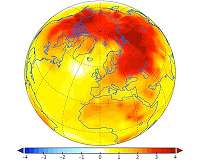
For the first time in over two decades, member states of the Arctic Council failed to agree on a final declaration at their bi-annual ministerial meeting on Tuesday, due to a US refusal to mention climate change.
At the start of the 11th gathering of Arctic foreign ministers, in the Lapland town of Rovaniemi, Finnish Foreign Minister Timo Soini announced a change to the planned agenda, saying the final joint declaration would be replaced by ministerial statements.
Several sources said it was because member states were unable to reach an agreement, with the United States alone refusing to mention climate change in the final text.
"I don't name and blame anybody," Soini, who chaired the meeting, told reporters.
"But of course it is clear that climate issues are different from the different viewpoints and the different capitals," he said.
In place of the traditional declaration, the council released a shorter "ministerial statement", which set out future goals for the organisation but conspicuously made no mention of climate change.
But Soini also took the unusual step of releasing much of the rejected declaration — complete with climate goals — as a "chair's statement".
"The hang up here right now is America making it hard to make a final agreement," Sally Swetzof of the Aleut International Association, one of six organisations representing indigenous peoples, told AFP.
The Arctic Council groups Canada, Denmark, Finland, Iceland, Norway, Russia, Sweden, and the United States, and their cooperation is usually frictionless.
– 'Doing our part' –
US Secretary of State Mike Pompeo assured his Arctic counterparts that "the Trump administration shares your deep commitment to environmental stewardship."
He insisted America was "doing our part" in protecting the climate, and said the US has reduced emissions of black carbon more than any other Arctic Council member state.
The US has repeatedly pointed to Russia's failure to submit information about its own emissions as a reason why environmental targets do not work.
"Collective goals, even when well intentioned, are not always the answer," Pompeo told the meeting.
"They are rendered meaningless, even counterproductive, as soon as one nation fails to comply," he said.
In a speech on the eve of the meeting, Pompeo instead pledged to strengthen the US's Arctic presence to keep in check the "aggressive attitude" of China and Russia in the resource-rich region.
On Tuesday China's foreign ministry hit back at Pompeo's remarks, calling them "a misrepresentation of the facts that has ulterior motives".
The Secretary of State's speech also drew strong criticism from some pressure groups.
"America's Arctic ambivalence is a far greater threat than the ambitions of Russia and China combined," Victoria Herrmann of the Arctic Institute said in a statement.
"With no strong fleet of icebreakers, no Arctic ambassador, and no climate change policy, America is arguably the weakest circumpolar nation, and shows no signs of correcting course," she said.
Scientists have warned that global warming is progressing twice as fast in the Arctic as in the rest of the world.
Representatives of the indigenous Arctic communities at the meeting called for urgent action against climate change.
"The animals, birds and fish that we rely on for cultural survival are increasingly under stress," James Stotts from the Inuit Circumpolar Council said.
"It's time to set the record straight. there is climate change and humans are responsible for most of it."
China says Pompeo's Arctic comments a 'misrepresentation of facts'
Beijing (AFP) May 7, 2019 –
China Tuesday hit back at US criticism of its Arctic presence, saying Secretary of State Mike Pompeo had misrepresented facts about its intentions in the resource-rich region.
Pompeo said ahead of a meeting of the eight members of the Arctic Council in Finland on Monday that the US planned to beef up its presence in the region to keep Russia and China's "aggressive behaviour" there in check.
Pompeo's remarks were "a misrepresentation of the facts that has ulterior motives", Chinese foreign ministry spokesman Geng Shuang said at a regular press briefing.
"We have no geopolitical calculations, and seek no exclusionary blocs," he said.
Pompeo warned against scenarios whereby nations become ensnared by debt and corruption, of low-quality investments, militarisation and uncontrolled exploitation of natural resources, all of which he said were potential effects of allowing rising Chinese influence.
Geng said China has participated in Arctic affairs with "an open, cooperative and win-win attitude".
China will "not intervene" in matters between Arctic countries, but it will also "not be absent" from global issues on the Arctic, he said.
While the US and Russia are members of the Arctic Council, China holds only observer status in the cooperation body and Washington has been wary of Beijing's attempts to style itself as a "near Arctic state".
Shuang said "the Arctic issue is not only related to Arctic countries, but is also of global significance and international influence".
He said China is willing to work with others to "protect the Arctic, to exploit the Arctic and to participate in the governance of the Arctic".
Beijing has invested massively in the region — almost $90 billion between 2012 and 2017, according to Pompeo — and intends to fully benefit from the advantages of the Northern Sea Route.
The shipping channel, which drastically cuts sailing times between the Pacific and Atlantic by passing north of Russia, is increasingly usable as the ice melts.
